
Podcast Episode #4
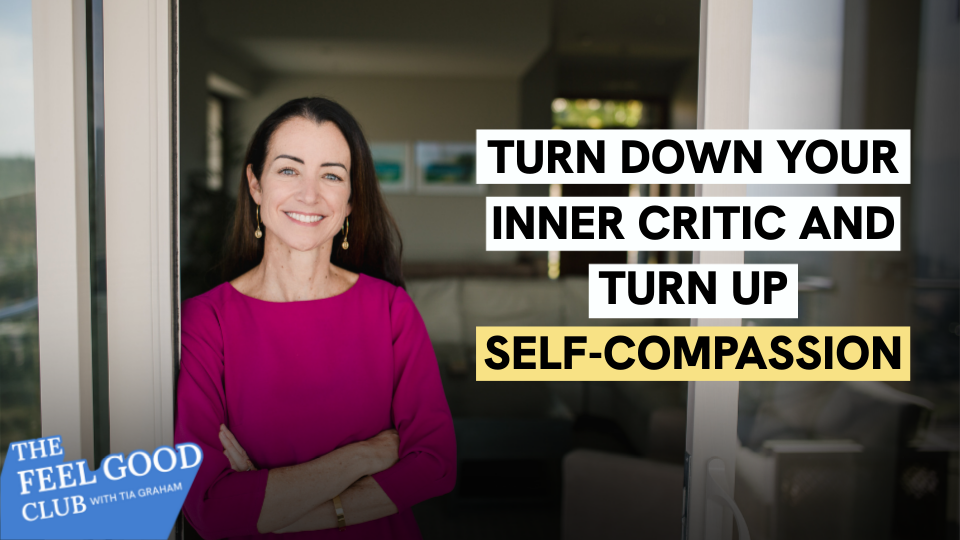



Embracing Self-Compassion: A Working Mom’s Guide to Thriving
Working motherhood often comes with an inner critic that never seems to rest. In the Feel Good Club podcast, Tia Graham shares how self-compassion can quiet that voice and boost both happiness and success.
The Inner Critic Trap
Tia explains that negative self-talk is a biological stress response — our brains try to protect us but instead trigger overwhelm. This reaction can drain joy and confidence, making self-kindness a powerful antidote.
From Criticism to Compassion
Tia recalls a hectic dinner when she felt like she was failing as a mom. Learning her daughter’s behavior was rooted in a nervous system difference helped her replace frustration with understanding. That shift toward compassion transformed her family dynamic.
Three Steps to Self-Compassion (Dr. Kristen Neff)
Self-Kindness: Speak to yourself as gently as you would to a friend.
Mindfulness: Notice your thoughts without judgment; awareness leads to calm.
Common Humanity: Remember, every mom struggles—none of us are alone.
HERE ARE THE 3 KEY TAKEAWAYS FROM THIS EPISODE:
1️⃣ Self-compassion rewires stress into strength.
2️⃣ Giving yourself empathy and kindness beats self-criticism.
3️⃣ Shared struggles of working moms create connection and growth.
7 STEPS TO OVERCOME MOM GUILT
Grab the FREE 7 STEPS TO OVERCOMING MOM GUILT
This free resource will help you change your mindset and change how you plan your time.
“Learn to speak to yourself the way that you speak to your best friend.”
Full Transcript
Tia Graham (00:02.059)
You can become your own best friend and completely change how you experience life and how you bounce back from mistakes. This is how I turned down my inner critic and turned up self-compassion. If I can do it, so can you. My working mom inner critic was so loud.
for a decade. And I really wish that I learned this sooner, but here we are.
Self-criticism has deep biological roots in human evolution and brain function, serving as a survival mechanism that persists today.
Your negative self-talk, my negative self-talk activates our amygdala, our brain's emotional center, triggering stress responses and cortisol release, which strengthens neural pathways through neuroplasticity. The more it's repeated, the more automatic it becomes. And we want to create the opposite neural pathways, right?
You think that having a loud inner critic pushes you, motivates you, helps you, but really it causes you stress, decreases your happiness and affects how you show up at work and with your family. Choosing self-kindness and mindfulness is a much better path for you and I, I promise.
Tia Graham (01:55.95)
Let me share a story. It is 5.20 p.m. and I am finishing making dinner, which I do not enjoy doing that much, especially when the kids are hungry and when I'm rushed and I am anticipating that they're not gonna want to eat the healthy food that I want to eat them. My girls at the time are five and seven years old.
They're arguing over something on the other side of the island and my husband is trying to calm the situation down.
My heart is beating fast and I feel overwhelmed and anxious knowing that they're hungry, irritable, and my husband is stressed with the fighting. Okay, dinner is ready. Everyone come to the table, please. My five-year-old comes and sits down immediately. My seven-year-old walks the other way. I feel annoyed in my body.
and all of these annoyed thoughts start rushing through my brain. This isn't the first time that she's done this. Jim, please go and get her to come to the dinner table.
He leaves and comes back in a few minutes. She will not come. What do you mean? Make her come, please. Tia, I can't. My voice is louder and stressed and certainly not as nice. You need to come to the dinner table now, I say to her. You need to come and eat with our family.
Tia Graham (03:46.512)
Now, she yells back.
This is unacceptable. I am tired of this. We need to all sit and have family dinners.
I turned to my husband. I don't understand how or why you cannot get your child to come to the table. What kind of father are you? Now he's even angrier. Dinner is not a good experience. My older daughter does not come. I go to bed feeling horrible. I feel like I am the worst mom in the entire world. I know that I'm not good enough. I am crying.
I am talking to my husband nonstop about what he's doing wrong, what I'm doing wrong, what we're always doing wrong. I'm sharing all of my fears, all of my worries, and I have a horrible night's sleep. And I wake up grumpy.
Later that year, we learned that my daughter has a rare profile of autism, a nervous system disability. And a huge part of her disability is that she has a survival drive for autonomy. This means her nervous system, her autonomic nervous system needs autonomy to feel safe. This is why
Tia Graham (05:16.032)
It is hard for her to come sit at the dinner table when she doesn't want to.
So you might be showing up as a mom, as a working mom, in different ways, that you immediately feel shame after, or guilt, or regret. And you're like, I'm not doing it right. I'm messing up. Well, guess what? Welcome. This is part of the experience, right? And so instead of constant self-criticism,
This loud inner critic that keeps telling you that you suck and you're not good enough. The solution is self-love. And how do you do this? How do you love yourself as a working mom who messes up? It's about prioritizing your mental and emotional wellbeing using science. And
Dr. Kristin Neff is one of the leading researchers on self-compassion. I highly recommend that you read her book and that you get her workbook and that you listen to her meditations. They are transformational and all research-based. So here are the three steps to self-compassion. Number one is self-kindness.
you talk to yourself the way that you talk to your best friend. And the more that you do this, remember your brain is plastic, there's neuroplasticity, you can change your neural pathways any single day at any point. You're never stuck. So it is talking to yourself, like let's say you've lost it at one of your kids because they've triggered you and you're a human.
Tia Graham (07:18.39)
You say to yourself something light.
It's okay that you lost it. You are a great mom. You are a great working mom. You are doing your very, very best. You got triggered. 90 % of the time you are great and it's not expected that you are perfectly calm and regulated at all times. You're doing your best. You're doing great. And tomorrow is a new day. That's how your best friend talks to you.
and you can learn to talk to yourself this way. I've been doing this for the last three years, life-changing. So that's step one, self-kindness. Step two is mindfulness. By meditating with guided meditations, by practicing just being silent and connecting to what you're thinking about, how you're feeling, what's happening in your body, and by even practicing informal mindfulness,
For example, when you're in the shower, tune into your five senses. Instead of just having your monkey mind go, go, go, and maybe think about all the things that you're not doing perfectly, you tune into what am I hearing? What am I smelling? What am I feeling? What am I touching? What do I taste? And the more that you just get present and mindful to the experience, the more you can notice how and when you are self-critical.
So you realize this isn't you, this is just this voice and it's based on evolution. And it's not that you're doing everything wrong, right? So the more mindful you are, the more easy it is to turn down that inner critic and turn up self-compassion and self-kindness. And then step three is common humanity, all right? So common humanity is recognizing
Tia Graham (09:21.42)
remembering and acknowledging that all us working moms were the same. We all have inner critics. We all mess up and then try and repair, right? We all are learning as we go, right? As we're getting older, we're learning how to be this human parent. This is our first time doing it with these kids in this life, right? So just...
especially during the hard moments, close your eyes and tune in to all the other millions and millions of working moms around the world that are also struggling and suffering.
So choosing self-compassion is an act of self-love. You're prioritizing your mental and emotional well-being by number one, self-kindness, number two, mindfulness, and number three, common humanity. You can practice this in your head, out loud, writing it down and do it in front of your kids. You want to model self-compassion.
so that they grow up to be self-compassionate as teens, as young adults, as adults, as parents. You can grow these neural pathways.
You're not wired to be super kind and super present with yourself. You're not wired to always think about common humanity. And being a working parent can give you a million reasons to be critical. But you can absolutely like me turn down that inner critic and turn up the self-compassion and be more successful in your career as well as in your marriage and your parenting.
Tia Graham (11:15.414)
and you're gonna be happier. I want you to follow and connect with me on Instagram, send me a DM, my handle is at T-I-E-Gram, that's T-I-A-E-Gram, G-R-A-H-A-M, and remember to prioritize your daily happiness. See you for the next episode.