
From Surviving to Thriving in Your Career and at Home



When motherhood and success feel like competing demands, you can redefine what thriving looks like on your terms.
Here’s How.
In this episode, Dr. Anne Welsh explores the ambition paradox: the pressure modern mothers feel to excel at work while also being endlessly available, selfless, and emotionally present at home. That tension can lead to overfunctioning, perfectionism, people-pleasing, and the constant feeling that you’re never doing enough. Instead of treating career and motherhood as separate lives you have to perfectly balance, Anne invites moms to see how deeply connected they are and how both can be shaped by your own values.
The shift starts by questioning the expectations you’ve absorbed. Ambition does not have to be a ladder you climb at the expense of your well-being. It can be a web that includes career growth, creativity, connection, rest, family, and personal fulfillment. When you practice self-compassion, name your own needs, and allow your definition of success to change with your season of life, ambition becomes less about proving and more about living in alignment.
HERE ARE THE 3 KEY TAKEAWAYS FROM THIS EPISODE:
1️⃣ Ambition can include well-being.
2️⃣ Perfectionism keeps moms stuck.
3️⃣ Define success by your values.
THE OVERCOMING MOM GUILT TOOLKIT
Grab the FREE THE OVERCOMING MOM GUILT TOOLKIT
This free resource will help you finally make your home life happier and more balanced.
Get the Free THE OVERCOMING MOM GUILT TOOLKIT
“Ambition is going after something that you really want. It can be money, power, achievement, or connection, impact, rest, play, or creativity.”
Guest Appearing in this Episode
Dr. Anne Welsh
Dr. Anne Welsh is a clinical psychologist, executive coach, and consultant who helps working mothers and leaders navigate ambition, motherhood, identity, and burnout. Through her work, she supports women in redefining success beyond perfectionism and impossible expectations. Her approach blends psychology, coaching, and real-life motherhood experience to help women build lives that are both ambitious and sustainable.
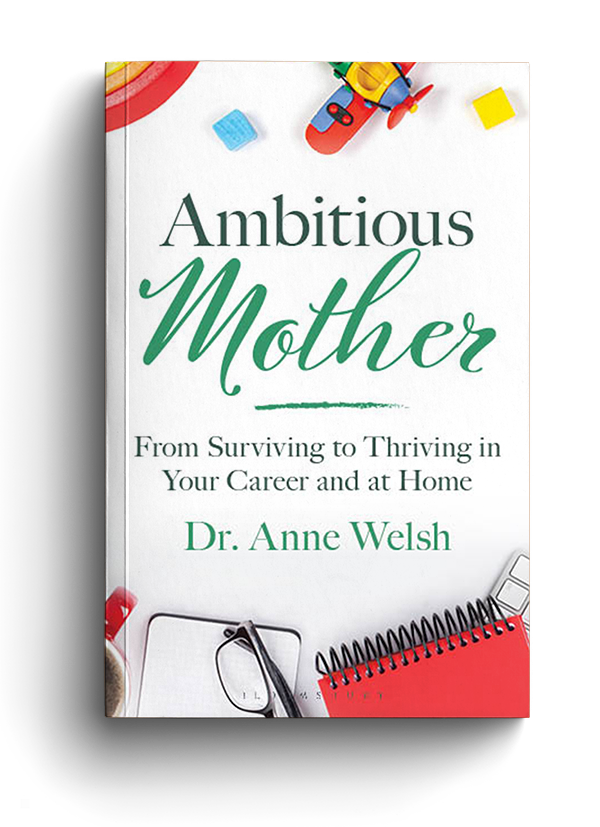
Ambitious Mother
Dr. Anne Welsh
Full Transcript
Tia Graham (00:02.19)
Okay, hold on. I'm getting I've never seen this. It says an error occurred, so one sec. Actual recording is higher quality. Okay, I think we're recording. Yeah. Yeah, it looks good. Okay, perfect. Hi Anne, welcome to the Feel Good Club.
Anne (00:10.367)
I think that's recording on my end.
Anne (00:18.897)
I am so excited to be here today. Thanks for having me.
Tia Graham (00:22.092)
My pleasure. I'm excited to learn from you and hear about your stories. So your new book, Ambitious Mother, great title, by the way, is coming out. And my first question is: what is the ambition paradox?
Anne (00:42.657)
Yeah, so this was kind of the first idea that I started working with when I was writing this book, and it came really from all of my client-facing work. And it's this idea that we are told that we have to work in a certain way and mother in a certain way, and it becomes this unsolvable problem, right? That's what a paradox is an unsolvable problem. And to meet the expectations of modern motherhood and meet the expectations of the modern workforce is literally an unsolvable problem.
And what I see women doing is essentially kind of spreading themselves thinner and thinner and thinner trying to do it to the extent that they are transparent in their own life. Like they don't even exist anymore outside of trying to meet everybody else's needs. And it's making them miserable. But they keep doubling down on the solution of just give more and give more and give more, hoping that that will make it better. And they feel trapped.
Tia Graham (01:37.134)
Such a beautiful explanation. Where in your research, in your opinion, and your experience, where are these two unrealistic modern ideals coming from? You know, thinking about how you're supposed to be as a mom and how you're supposed to be as an ambitious career person. And there's
Right. These standards that are like if you do all this and I can't do this and if I do all this, and so you constantly feel like not enough or failing or not living up, but who's I guess where's the messaging coming from and and where do you think this is yeah, how it's how it's impacting?
Anne (02:21.547)
Yeah. And I I kind of have two answers for you because the w where the messaging is coming from is multifaceted. But to start with, right, the problem is that both like kind of how we're societally de defining these things are treating them as like separate buckets and treating them as if the other doesn't exist. Right. So we treat motherhood and work as separate silos and we have a story that they rob from each other.
And the expectations around them are such that you're only doing that thing. But the reality is the world has changed. Women are working. It is not gonna hurt your kids to work. In fact, it can be good for your kids, and we can get into that data later. and while women are working, we're actually escalating what we're asking them to do as mothers. So it's not even that they're doing both and they just didn't use to do both. It's
In fact, what I see is the more that women are showing up at work, we as a culture are actually asking them to do more and more and more at home. Right. And so we have data that women who are working moms right now are spending more time with their children than at home moms did in the 70s, right? And that's a huge shift. and and not even in the last ten years I've seen i it it's kind of been exponential in terms of the amount of time
Tia Graham (03:37.966)
Yeah.
Anne (03:46.081)
Focus, energy, kind of play oriented stuff that we are supposed to do with our kids to qualify as quote a good mom.
Tia Graham (03:54.839)
It's so fascinating. And I've said more than once, gosh, I should have been a 70s mom or like 80s, because I was born in 1980, right? Of just such differences. And then of course you can go back even to how moms were in the 50s, and and yeah, it's so different. So let me ask one question what you said, and then I'll then I'll move on. How come working moms are choosing to spend more time?
Anne (03:55.455)
Mm.
Tia Graham (04:23.916)
with their children. And and the research shows that dads are spending more time with their children too, right? Both, but mums more. But how come? Why are we doing this? Because I fall in this bucket for sure.
Anne (04:35.189)
Yeah, you know, I think a little bit of it is there's a lot of a lot of like possibilities. Certainly one is like I ideally is we have more reproductive choice. We are choosing to have kids, we are maybe having less kids and want to be more invested in them. And also psychologically we have more and more understanding of the importance of kind of social emotional learning and the role of parenting in that.
Tia Graham (05:01.784)
Yeah.
Anne (05:03.215)
you know, so I think that there is this more intentional parenting happening. we want to be involved. But I think the missed piece sometimes is that we are equating quantity with quality in terms of our involvement with our kids. And that's the where the data suggests maybe we're we're kind of using the wrong metric.
Tia Graham (05:10.156)
Yeah.
Tia Graham (05:17.326)
Mm-hmm.
Tia Graham (05:24.45)
Yeah.
Anne (05:24.533)
Right. And and it's really clear when we look at time studies that the amount of time that we spend with our kids does not actually have any outcomes or any bearing on kind of wellness outcomes. It's the emotional tenor, like the feeling that they have when they are with us. And so if we're with them for five or ten minutes at the end of the day, but we are present and we are asking them and we are delighting in what they are saying, that's better than spending a few hours with them.
Feeling bored or antsy or restless or stressing about work because we haven't actually had any time to like invest in ourselves.
Tia Graham (05:56.611)
Right.
Tia Graham (06:00.93)
Right, or haven't right, haven't haven't invested in our friendships or in our like movement or stillness or or all the different things. so you talk about three P's and I want to talk about two of them. Can you tell me how perfectionism and people pleasing connect for ambitious moms?
Anne (06:27.755)
Yeah, the big connection is f well, two, fear and disconnection from ourselves. In both cases, people pleasing and perfectionism are both about being afraid of something and focusing on other people's opinions of us. So with perfectionism, it's a fear of making mistakes. Like a lot of people think, I'm not a perfectionist, I don't have to get an A plus. I can I can have an A, that's fine, right? I probably was that way in high school. but it's not actually about that, right?
Perfectionism is more like I can't make a mistake. I can't let people see that I am flawed. I, you know, essentially I can't be a human being. it's like, yeah, I can get an A, but if I got a B, that might as well be an F kind of idea. and it is again, it's this other people have to see this version of me that is not struggling. And people pleasing is really similar, actually. It is a fear of upsetting someone else or of disappointing someone else. And it is
Again, I can't do something that someone else would not approve of. And both things are external facing and they take us deeper and deeper away from our own needs, our own wants, our own desires, right? Like both of them are highly focused on do I deserve things rather than do I desire things.
Tia Graham (07:44.397)
Hmm, so interesting. As you were talking, I was thinking that I wonder if ambitious moms, and I'd love to hear your thoughts on this, on ambitious moms, I hopefully I'll say this right, people please with their kids because there's a fear of I'm working, so maybe I'm harming them, so I need to make sure that I do a lot for them, and maybe that adds more time.
But like, can you actually want to whether it's conscious or subconscious, people please your kids maybe because you have mom guilt or et cetera.
Anne (08:23.799)
I think that can totally happen. Absolutely, right? Where it becomes I don't want to disappoint my kid so I don't do the thing that I maybe need to do for myself. And I totally struggled with this when my kids were little. Like I I think a lot of us do this, right? Of I don't want them to be sad and miss mommy at bedtime. And I kind of want to see them at bedtime so I won't go out with my friends. Or I won't go to that yoga class because they'll miss me in the morning or even little things like
I won't make dinner that I like, we'll just have pizza every single night because that's the only thing that they are willing to eat. And you know, all of these are ways of saying everyone else's needs matter more than I mine do. And the problem is that when we make motherhood martyrdom like that, we lose the joy in it, but also it's not good for our kids or us, right? Like it actually deteriorates our own mental health, and our mental health is actually helpful for our children.
Tia Graham (09:22.766)
Right, right. Yeah. I mean, that is my whole message is for working moms to prioritize their well-being, to prioritize their happiness, and to do it even when there's discomfort, right? Like to go to that yoga class or to take that course that you want to take because you're, you know, you're gonna get a lot of happiness from that professional development, that learning and growing, etc.
And that your kids, of course, you benefit, but your kids benefit, you know, from it. so you write and talk about finding your own version of ambition that fits your values. So it seems like there's this, like maybe public or societal version of ambition that we see. And so
Is it is it hard for in your experience and and with all the working moms that work with for these ambitious for ambitious moms to find their own version of this and feel okay with it and feel good about it?
Anne (10:37.857)
Think it's hard until you've done it and you realize how much better it actually feels. And the big reframe I ask people to do is that like that cultural version that we've been taught about what ambition is, is that like career ladder, right? Like you climb, it's one rung after the other, and it really only leaves room to be ambitious for title, money, status, kind of these traditional achievement can maybe be on that that ladder.
And also with that model, if you're not ambitious for those things, you have quote fallen off the ladder. Right? It's like it's very, again, very black and white, back to that ridge of thinking we were talking about with perfectionism. And so what I tell my clients is that instead of thinking about ambition as the ladder, we need to think about ambition as a web. And you can think about a spider web. If you don't like spiders, you can think about like one of those playground webs that like your that's my favorite version of it, right? Your kids maybe have played on a
Tia Graham (11:18.21)
Right.
Anne (11:34.668)
There's kids climbing in every direction and hanging upside down. And maybe someone's like sitting in the corner eating a snack. And that's really what ambition is, right? Ambition is going after something that you really want. And it can be money, it can be power, it can be achievement. Those are great goals. It can also be connection or impact or rest or play or creativity, right? And so once we widen how we're defining ambition.
then you don't have to say it's an either or game. It's not ambition or motherhood. It's ambition and motherhood. Ambition because of motherhood. And it gets to weave and change directions as your kids and you grow and change through the process of mothering.
Tia Graham (12:21.114)
And when you were saying, because the number one predictor of happiness is human connection, this is what the science of happiness, you know, has proven is that being ambitious about connection, and this could be with your spouse, with friends, with family members, with your kids, of course, foot on yourself with yourself as well, it's not something that
Anne (12:29.247)
Yeah.
Tia Graham (12:47.474)
is visible necessarily, right? Like you said, the the title or the money or the awards or the accolades or you name it.
But it's realizing that like just what that gives you and letting go of, yeah, this might be invisible and this isn't something that society is bragging about, but actually we should be, you know, of of how how important it is. and then the other thing I thought of is title and money, if you think about like the origins of that, it was not.
Anne (13:14.037)
Yeah.
Tia Graham (13:26.754)
women caring for children and like raising people, right? These are men not focusing on not primarily focusing on kids. So it's like this this ladder that isn't actually our ladder in a way.
Anne (13:41.132)
Right, right. And and I think sometimes even to add another layer with the money piece, like sometimes the way we are honoring our children is money and to make some permission for that being on the web, right? That's why I don't think it's even like that those things are bad. Maybe part of what we're doing is is ambitious for economic stability to provide it for our children. And that's a beautiful way of
of connecting with them and providing so that there's space for all of it. But again to like you just said, like recognize that original ladder was never ours to climb in some ways.
Tia Graham (14:15.628)
Right, right, yeah. what are the three patterns that keep ambitious working moms stuck or in overfunctioning mode? What are the patterns?
Anne (14:31.425)
Well, and so we already got to two of those, right? So the perfectionism and the people pleasing, right? Because with each of those, the salute you're on a bit of a hamster wheel, right? Of like running away from something. And you never actually get any sort of feedback that you've done enough, right? I if you think of perfectionism, it's like an if anyone can remember their high school math, it's an asymptote, right? Like
Tia Graham (14:34.231)
Okay.
Anne (14:56.139)
You it's this line that curves and curves and curves, but never quite gets to a point where you're done because you can't ever get to perfect. And so you're just continually trying to prove yourself, improve yourself, improve yourself again. And the same with people pleasing, right? You will never make everybody happy. It's impossible. And so you keep trying and you trying and you're trying, thinking this is an achievable goal and yet it's not. And the third is pretending.
And this goes along with both of them, of saying, whether it's pretending to other people, I have it all together, I don't need help, I'm fine, or pretending to yourself. And I see this a lot of times of women who are not really seeing how or don't feel safe to name how unhappy that they actually are, and that keeps them stuck as well. Right. And when we start naming these patterns, then we can start making changes.
Tia Graham (15:32.27)
Mm-hmm.
Tia Graham (15:48.655)
So, so important, immediately you made me think of so we have two children, and our older daughter is has a rare profile of autism and has a lot of different, it's been a very challenging parenting journey. And I remember crying to one of like we've had a several, but the our autistic parenting coach and crying about something and saying, like,
Anne (15:49.015)
Mm.
Tia Graham (16:18.058)
Exactly what you're saying. Like, I'm not okay. Like, I want to change. I'm not okay. I feel stuck. And I've always been a working mom. I've never stopped working and I love working. And you know, she gave me the permission of like, all right, you're not okay and you want to change. It's time for you to do something about it. Right? But that ad that admitting out loud of of it's it's not working, you know?
and so yeah, thank you for sharing all of these. So how can women move from unhealthy striving and some even get to a place of burnout, right, into something that's more grounded, sustainable, and I'm gonna say happier.
Anne (17:09.291)
Yeah. You know, unhealthy striving is ki is at the heart of that ambition paradox, right? So visually, if you think about people pleasing and pretending and perfectionism as like a Venn diagram, and the the ambition paradox sits in the middle, that like triple overlap, right? And that's also where unhealthy striving sits. Unhealthy striving feels like you're running away from the tiger. And I just have to keep running because I don't want to get caught, right? It's that fear I don't want to have make mistake, I don't want to disappoint anybody.
And there's always a sense with it, I think, of like, I'm gonna get this next thing and I'll feel better. I'll get the promotion. I'll have the kid. My kid will figure this thing out that's stressing them. They'll sleep through the night. I mean, maybe you will feel better when they sleep through the night, but the idea is like this next thing will happen and then it won't feel like this anymore. And the reality is the next thing happens and it still feels like this. Because again, you're not actually going after anything that you want, you're going after things
Kind of for the sake of it or because you've been told that's what you're supposed to do. With healthy striving, it's a very different embodied experience, right? You might still have really big goals. So often women are told, well, the solution is just have less goals, right? Don't be so ambitious and you'll feel better. Quit your job, downshift. If that's what you want to do, that's amazing, and I'm hugely supportive of that. But I can't, I don't think that's a one-size-fits-all solution. And so with healthy striving, it is.
naming a goal that you're actually invested in and then all of a sudden you get to enjoy the the the lead up to it as well, right? The the version I use is like you know, instead of running from the tiger, you're running after the ice cream truck. I really love ice cream, right? So that's where my brain goes. but it's like I'm really excited about getting that ice cream and also it's kind of fun to run with all the kids down my street and hear the music and anticipate it. And, you know, if I
Have to rest while I'm running after it, it's okay, because I know that it'll still be there, right? And and so with healthy striving, there's a sense of enjoying the journey, there's permission to refuel, there's permission to make mistakes along the way, right? And learn from them and not feel like it's so high high stakes. and you only get there by not engaging in these people pleasing imperfectionism and pretending patterns, right? To your point of saying, I'm not okay when you're not okay and getting help or
Anne (19:31.5)
Saying, you know what, sometimes life, you know, 80% is enough, right? Like a a bee gets the job done. Or of saying, you know, I want this thing and it's gonna disappoint someone else. And I can handle that. I can tolerate it. My job is to to make that ask, they get to have their feelings about it. and so it is a very we might the goal might not even change. In all honesty, there may be goals that you were this that are the same, but your mentality of chasing it is very, very different.
Tia Graham (19:31.502)
Mm-hmm.
Tia Graham (20:01.762)
Right, right. Immediately I thought of so from Dr. Ben Shahar, who taught positive psychology at Harvard, and I studied with him for a year. He always talked about self-concordant goals of really making all of the noise, whether it's family, culture, social media, what your friends are doing, and getting just really quiet of like what you want.
Anne (20:16.864)
Yeah.
Tia Graham (20:30.666)
And so, you know, I I wrote that down. And it's interesting because there is such an expectation of things will be so different when I achieve that goal. But so much of our life, probably 99%, is that journey piece, right? And so if the goal isn't yours, and if if you're not fully aligned with it, and I know you talk lots about values,
You probably will be really disappointed when you get there. And then it's going to be, yeah, harder along the way. so if there's someone listening that's thinking, gosh, I don't really know what I want, or how do I figure out what I really want? And I'm an ambitious working mom, and I, you know, I don't want to be a stay-at-home mom. I really want to work, but I am maybe in that unhealthy striving.
Where do you suggest that people start?
Anne (21:34.274)
Yeah. First of all, to just validate that I think a lot of people are at that spot. And as women, we're really socialized to to go there, right? Like from the minute we enter this earth as women, we are told that our purpose is to make everybody else happy. Right? We are socialized to people please, we are socialized to be martyrs, and then you especially when you become a mother, right? Like we've almost made mud motherhood and martyrdom synonymous, even though they aren't.
Right, so there's you've received so much messaging that your wants don't matter. And I kind of describe it as like an atrophied muscle, right? One that you just essentially haven't used. So you don't know how to. And so just like if you were going to start working out for the first time, you don't start with a marathon, right? You start by maybe doing like a couch to 5K program. Sometimes we have to do that with naming our wants. And so
It's gonna be like a quiet whisper. It's not gonna be like, yes, I've always known I wanted to do this big thing and I never did it. It might be, what do I actually want for dinner? Like that might be a really hard question. Or what do I want to do with an hour the hour of free time I have? You know, like my my kids are four kids between the ages of 10 and 17. My weekends do not feel like my own right now, but there's usually at least an hour or two where I can kind of say, hey, I wanna do this thing with that time.
the other suggestion I have is to just notice what I call the breadcrumbs of joy. Like you maybe you can't even notice your wants, but can you notice little things that feel good? or you know, another term we can use is glimmers from Deb Dana's work, right? Is like, what are the things that feel a little sparkly in your life? And it doesn't have to be like again, overall like just total overwhelming joy. It might be like for me, a big one is
Tia Graham (23:10.03)
Mm-hmm. Yeah.
Anne (23:23.211)
Having a cup of tea after lunch. I do it every day. I don't do anything. It's like five minutes of mindfulness with my cup of tea and it makes me really happy. It's not a big thing. or you know, when I first started working on my book, it was like, I I didn't know I was working on a book. I was just writing. I just had sentences bubble up and I was like, right, I kind of I used to like writing. I used to do a lot of this before I had kids. And this is fun. And I like, let me see what happens with this. It's just like learning to tune into that.
Tia Graham (23:30.326)
Yeah.
Anne (23:53.153)
Feeling even.
Tia Graham (23:54.499)
Mm-hmm. Mm-hmm. And I love the exercise. And I want everyone who listens to journal or speak into your phone, right? And capture what do I actually want in the mornings? What do I actually want during my workday? What do I want in my afternoons, in my evenings, in my weekends?
And yes, you're not, it's not like, I want to go on a sabbatical to Bali for a month and leave my husband and kids. No, you might want that because you want to work. But like within you have you have your career, you have kids, you have house, everything, family, etc. But there's probably a lot of small shifts and things to stop doing or start doing to just
Just think about, you know, and I love the question all also, how do I want to feel? You know, there were many years, and I don't know if you can relate to this, there were many years where my goal, because I had big career, kids, travel, like everything. My goal was feeling calmer and being calmer. Because I was so fast-paced, it was so, and I, you know, I spent several years really focused on that.
just slowing down and calm. and I'm so grateful, you know, I I definitely feel way calmer than I used to, that, you know, connecting to not just what you want to do, but just how do you want to feel with all in all of it.
Anne (25:34.946)
Yeah. Yeah. And I think sometimes we can think that we have to like blow up our life to make a change, right? And it more often than not, what I see is that it is the really small thing that builds. And and I I like to use the analogy of like a compass, right? My one of my boys is super into Boy Scouts and they go do like orienteering practice, right? Where they take a compass and they're in the woods and it's like point your compass to 25 degrees and take ten paces. Now for ten paces, if they get are at 30 degrees instead of 25, they're gonna still get to the same tree. Like it's not a big deal.
But my airline pilot and my like transatlantic flight is off by 25 degrees. We will land in an entirely different country. It's a it's a good or bad thing, depending. Right. And so that's the kind of shifts that that one degree compass change doesn't feel like much in the moment, but it's the thing that starts you down a whole different trajectory. And a year down the road could land you in a very different place and have a very profound impact if you kind of just trust the process a little bit.
Tia Graham (26:27.118)
Mm-hmm.
Yes, yes, I love that. You're inspiring me to do some more journaling. So what are three things? You mentioned a cup of tea. What are three additional things that you do as an ambitious mother of four that help feel good?
Anne (26:51.895)
Great question. so I lift weights most mornings. I fell in love with that probably five or six years ago. And it is like my hap mentally happy place. Like
Tia Graham (27:03.948)
Okay, how do you lift weights most mornings? Tell I wanna hear what you do.
Anne (27:08.351)
Well, I so I wait I do wake up at five and do it before the kids get up. That would and I wan I say this with a bit of a pause because if someone w when I had little kids that would not have been an op right. My youngest is ten, so I am they if they wake up, which they rarely choose to do before six in the morning, they can entertain themselves and it's fine, right? And so when they were little that was not an option. There were other things they did. But that
Tia Graham (27:20.32)
Absolutely. You're in a different phase, yes.
Anne (27:37.974)
Yeah, I mentioned my cup of tea. I also just really love even if it's five minutes family like family dinner, sometimes with all of their activities, it is only two or three or one of the kids, but to have like at least five minutes of conversation where most of us are together is real and and again, when they were little, family dinners were not necessarily that experience. There's a lot of wonderfulness. I mean, people always tell you you'll miss the little years, and I do in some ways, but
Tia Graham (27:49.167)
yeah. I've checked it down here.
Anne (28:06.773)
Gosh, parenting tweens and teens is rewarding in a lot of ways. I love it. so that's another really positive thing. and then taking a walk every night with my husband after dinner. We we have a dog, we take him for a walk together, and like that's our time separate from the family time, and it's 10 minutes. it's something we have to do, right? It's like multitasking, the dog needs to go out, but it w we get to do it together most nights, and it's a nice little chance for us to just connect too.
Tia Graham (28:33.582)
That's a great one. One of the working moms that I know through my daughter's soccer team, her and her husband go for a walk right after their kids fall asleep. So you're like, Yeah, your kids probably aren't gonna get kidnapped. You know, we we do live in a safe, we live in Orange County, California. So it is quite safe. But I was like, that's cool too. Of of just, you know, thinking about that. well, thank you for sharing that.
Anne (28:43.159)
you know their kids will actually sleep for a little bit. Yeah.
Tia Graham (29:00.926)
And where can people go to connect with you and learn more?
Anne (29:06.027)
Yeah, Dr. Ann Welsh is my website. It's also my Instagram handle as Dr. Ann Welsh. I'm also on LinkedIn as Dr. Ann Welsh. so you can learn about my services. and then the book Ambitious Mother is available anywhere that books are sold. And right now there's some amazing pre-order bonuses that you can get access to right away if you order the book before its release date on August 6th.
Tia Graham (29:28.278)
well thank you for coming on the show and thanks for all the great work that you do for Ambitious Mom.
Anne (29:36.299)
Thank you so much for having me. This was a great fun conversation.