
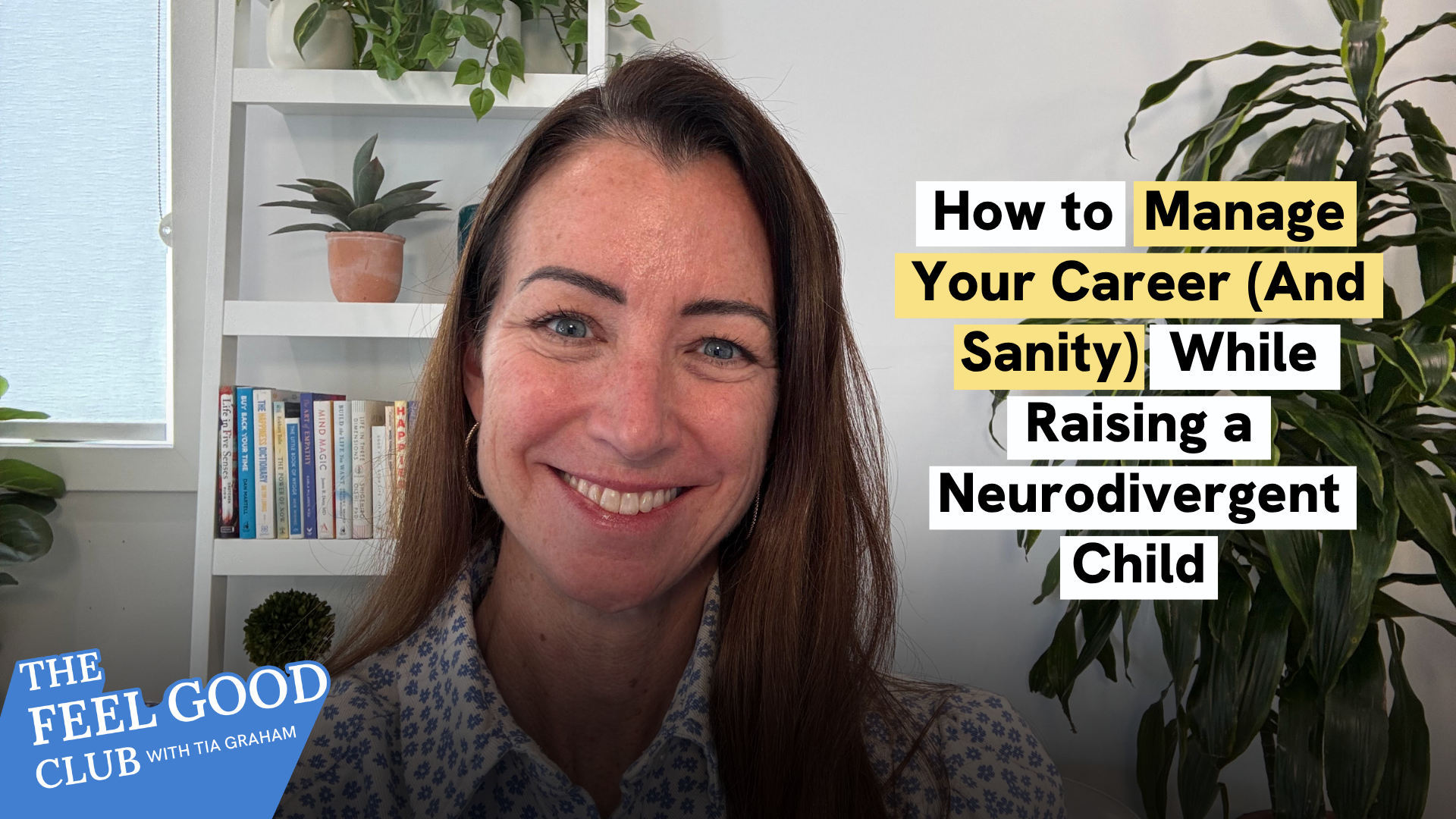
How to Manage Your Career (And Sanity) While Raising a Neurodivergent Child



You Are Already Empowered, Even in the Middle of the Mess.
Tia unpacked something so many working moms raising neurodivergent kids carry quietly: the exhausting gap between how put-together your life looks and how held-together it actually feels. She named the hidden pressure of managing school calls, therapy appointments, meltdowns, and a career, all while comparing yourself to moms whose lives look nothing like yours. That comparison, she explained, isn't fair to you, because you're carrying a harder version of two full-time jobs at once. The mindset shift she offered cuts right through the waiting game so many moms play: you don't need conditions to improve before you're allowed to feel capable. You already are.
Tia shared the story of a mom navigating fight-or-flight mornings with her son, who found her turning point not in a new parenting strategy, but in one sentence that changed how she saw herself. From there, Tia introduced the idea of life-work harmony instead of balance, a framework built around your actual circumstances, not a perfect 50/50 split. She also offered a simple practice for hard moments: ask what's within your control right now, what can wait, and what would help you recover instead of spiral. One hard moment, she reminded listeners, doesn't have to become a hard day.
HERE ARE THE 3 KEY TAKEAWAYS FROM THIS EPISODE:
1️⃣ You don't need life to get easier before you're allowed to feel capable.
2️⃣ Life-work harmony fits your real circumstances better than generic balance advice.
3️⃣ One difficult moment doesn't have to define the rest of your day.
LIVE VIRTUAL MASTERCLASS
Join Tia live for a masterclass: How to Manage Your Career and Sanity While Raising a Challenging, Neurodivergent Child.
Wednesday, September 30th, 2026, 10–11 AM PT / 1–2 PM ET.
“You don’t need to become empowered. You already are.”
Full Transcript
Tia Graham (00:03.64)
1047 a.m. Two minutes into an important Zoom call. Laptop is balancing on your knees, and the school's number flashes on your phone. You mute the call, answer, listen. Okay, yep, I'll be right there. I'm coming to pick her up.
You have to go back to the Zoom call, apologize that you need to end the call and reschedule. And you need to hop in your car and race to school.
Tia Graham (00:47.202)
This is not something that happens once or twice a year. This is something that happens a lot. And for you listening, that's just a regular Tuesday. Hi, I'm Tia Graham, founder of the Feel Good Club membership for ambitious moms with neurodivergent kids. And I'm the host of this podcast. This episode
is for working moms who are raising kids with ADHD, autism, PDA, ODD, or some other complex neurodivergent profile.
You're answering emails between school calls, researching therapies after your kids go to bed, filling out the same 20 page intake form, still trying to move your career forward, trying to keep your marriage warm, trying to fit in self-care, trying to keep friendships alive, trying to not snap.
Before dinner is ready, and if this is you, I see you, and you are not alone. In the next 10 minutes, I'm going to give you one real mindset shift and tools that you can use tomorrow. Proven tools that I use and that I share with my working mom clients. From the outside, your life looks pretty good.
You have a good job, or you're an entrepreneur, you have a nice house, you go on vacations, you have a nanny, and you know, LinkedIn and social media, things look pretty good. But privately, there's this quiet, specific shame. Not I'm struggling, but I have read so many flipping books. I've hired so many specialists.
Tia Graham (03:01.216)
I've gone to therapy. I've done every strategy, and it's still not enough. There's this quiet shame where you feel like you're failing. Failing as a mom, certainly not good enough in your career as all, at all. And that gap between how put together you look and how held together or not held together.
You actually feel that gap is so exhausting to maintain. And that is what we are unpacking today, because I'm on this journey with you.
So I'll tell you a story of, I'm gonna use a fake name of one of my clients, Sarah. All right, and she is in the Feel Good Club. So she is, she teaches classes, she's on several boards, and she's raising a nine-year-old son with ADHD and pathological demand avoidance, which is a profile of autism.
And she also has another child. Her partner gets really triggered by her child. And so she's not only managing work, the nonprofit, her paid work, her nonprofit work, her two kids, also her husband, and that dynamic. And even reasonable requests trigger her son into fight or flight.
Sometimes this can mean a 45 minute negotiation, a long meltdown, where everyone in the house is walking on eggshells. And she is not telling all her co workers about her mornings because you know she doesn't want anyone to think that she can't handle the job that she needs to do. And the other moms.
Tia Graham (05:11.828)
At school, don't necessarily get it because their kids' challenging challenges are tiny compared to what she is dealing with. She's carrying these two full time roles caregiving and working. And the turning point wasn't a new strategy for her son.
It was one sentence that I shared with her. You don't need to become empowered. You already are. Empowerment isn't a destination that arrives once your kid or your work or your marriage or the siblings or the house calms down.
Waiting on external conditions, always one school call away from feeling like you're failing. The shift for her was going from I'll be empowered once this gets easier to I'm already the kind of woman and human who can hold this right now in the middle of all of this mess. And you are more empowered right now.
Then you believe. Sarah's weeks change, not because mornings got easier, but because she stopped needing everything to be easier before she started to change. So the mindset shift, number one, is believing you're already empowered creates a calmer life, not the other way around. All right?
Point two is that there is a framework that can help you, a life work harmony that can serve you in this chaotic, super challenging life of being an ambitious working mom with a neurodivergent child. And most work-life balance advice was never ever built.
Tia Graham (07:32.303)
For the life that you and I were living. Because we are carrying an emotional load that other working moms could not possibly understand. You can't understand it unless you're walking this journey. And you can get trapped by comparing yourself to working moms with neurotypical kids, or by comparing yourself to stay-at-home moms with neurodivergent kids.
Both of those lives are very, very different than yours and I's, right? So you are doing a harder version of both jobs and to know that. And it's not this 50 50 split between caregiving and working. And once you stop comparing yourself to moms whose lives look really, really different, you're gonna find this inner peace and you're gonna
Create a framework, a life work, harmony framework that works for you. And for me, this mean this means, or mean doing less work travel. I had to accept that I can't travel as much as a working mom with neurotypical kids. I just can't. It's causing me too much anxiety. It's
You know, causing too much stress for the family. And it was hard to accept that. But that had that was part of the framework. And and you know, no decision that you're making now is forever, right? Another point I want you to know is that there's so much that's out of your control, and you will go crazy trying to.
Change and battle and go uphill with what is out of your control, right? There is a lot with your kids' life, with with how you can work, with how this affects your marriage and co-parenting that's out of your control. You can't control a 7:40 a.m. meltdown or a school call during meetings. You can't control that you get so many messages.
Tia Graham (09:56.153)
From school. You can't control that maybe your child like mine doesn't sleep through the night every single night. You can't control that you need to have your siblings apart more. And what you can control is whether these hard moments write the next story, write your story for the next eight hours, or if if a hard day makes you have a hard week.
There's things that you can control that you have agency over. And this is not at all about toxic positivity. No one walking your path is going to be positive all the time. It's about this was hard. I'm allowed to feel triggered, but I'm allowed to also choose that the rest of the day isn't ruined. All right. So again, recap: you are already empowered.
You don't have to wait to feel more capable. You can build a life work harmony rhythm around your actual life with your work and your challenging neurodivergent child, not someone else's. You can continuously choose to release what's out of your control and befriend your painful emotions instead.
Of fighting them. And none of these require your child to change. This all starts with you. I invite you to join my live virtual masterclass on September 30th for one hour at 10 a.m. Pacific or 1 p.m. Eastern. The title of the masterclass is
How to manage your career and your sanity while raising a challenging neurodivergent child. This is one hour live built just for you. You are going to walk away with my life work harmony framework built just for you, a companion guide, and if you come live, there's going to be another bonus.
Tia Graham (12:21.748)
If you can't make it live, no problem. The replay is going to be up for four days. And you're going to be in community with other ambitious moms with challenging neurodivergent kids. I'm also going to teach you how to transform your inner critic and the shame and the guilt and the voice that says you're failing or you're not enough into a wise woman.
That is so supportive and compassionate and kind to you. And I'm going to tell you exactly how I did that. So all you need to do is go to tiagram.com forward slash masterclass, and you can sign up for the September 30th event. It's $47, and you are going to walk away with tools that you can use the day after.
Thank you so much for listening. If this helped you, send it to another incredible working mom who needs it. And I will talk to you next week. Bye.