
How Working Moms Can Build A Life They Actually Love
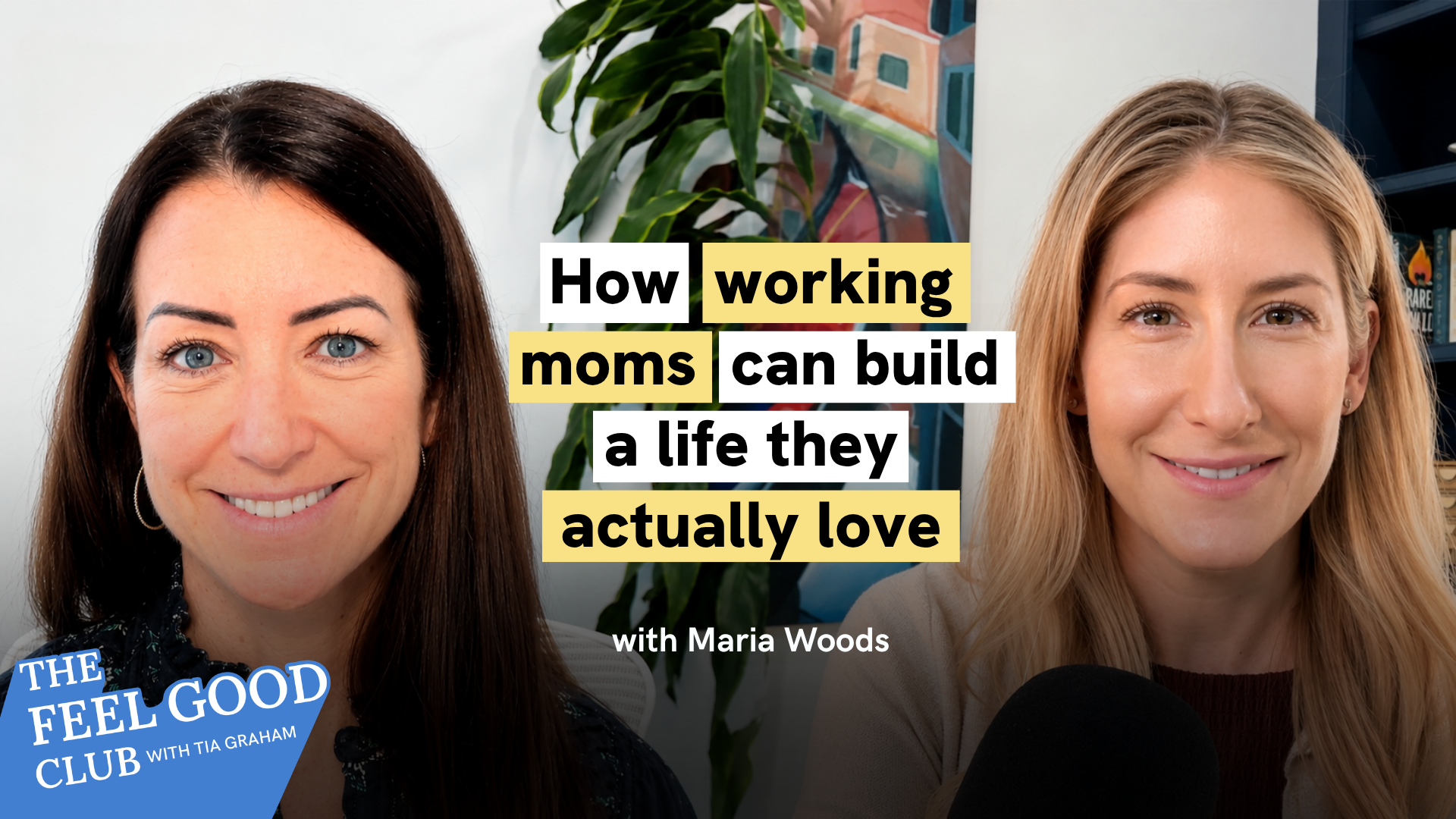



What if you didn't have to carry it alone?
Here’s How.
Maria Woods opened up about something every working mom feels but rarely names: the mental load. It's the constant background hum of remembering, organizing, and anticipating everyone's needs, and Maria explained how society quietly places most of that weight on moms. She shared her own turning point, realizing she had been internalizing responsibility that wasn't hers to carry alone, and how learning to voice her needs and ask for support changed everything. Asking for help, she reminds us, isn't weakness. It's strength.
Maria also talked about the power of flexibility. Rather than gripping tightly to a perfect schedule, she found more peace by allowing space for chaos and adjusting as life happened, especially after her second child. That shift, she says, made motherhood feel less like something to survive and more like something to actually enjoy. She also spoke about self-care as a non-negotiable, not something extra, but something that helps her show up more present and engaged with her kids, even if it's just a few quiet minutes a day.
HERE ARE THE 3 KEY TAKEAWAYS FROM THIS EPISODE:
1️⃣ The mental load is real, and you're not meant to carry it alone.
2️⃣ Flexibility makes motherhood feel lighter than rigid routines.
3️⃣ Small moments of self-care help you show up more present.
THE OVERCOMING MOM GUILT TOOLKIT
Grab the FREE THE OVERCOMING MOM GUILT TOOLKIT
This free resource will help you finally make your home life happier and more balanced.
Get the Free THE OVERCOMING MOM GUILT TOOLKIT
“The most radical thing a mother can do is to not feel guilty. Realizing that there’s an impossible standard — you can’t give all to work and all to your children simultaneously. It’s literally impossible.”
Guest Appearing in this Episode
About Maria Woods
Maria Woods brings a background in cultural anthropology, law, and business to her work exploring the realities of modern motherhood. After years in corporate America, becoming a mother reshaped how she saw balance, support, and identity, inspiring her to create a podcast dedicated to helping other moms feel less alone in the struggle. Her approach blends curiosity about people and systems with honest, lived experience, offering moms permission to ask for help and redefine what balance really looks like.
Full Transcript
Tia Graham (00:01.946)
Hi Maria, welcome to the Feel Good Club show.
Maria Woods (00:06.05)
Thank you. I'm thrilled to be here.
Tia Graham (00:09.306)
I want to start off by learning a little bit about your background and your story and tell us how come you are so passionate about supporting moms in your life right now.
Maria Woods (00:23.958)
Yes, great question. So I, in terms of an educational background, I studied cultural anthropology, which is the study of people and culture, how we pass meaning. So I just felt really drawn to that in terms of an undergraduate field of study. I didn't really know where it would lead. You know, was I going to get my PhD in anthropology? I didn't think so, but I just love studying it.
And then I did a law degree, business degree, and I loved classes like organizational behavior or classes on emotional intelligence. I then went to work in corporate America and branding and sales. And so I've just been fascinated by people, by structures, by our culture throughout kind of my life. And then while I was working, I became a mom and I have two kids now that are four and six.
And when I had my son, who's six, my first child, it was a little bit of a shock to the system for me. So I always wanted to...
Tia Graham (01:27.501)
it was a huge shock to my system. Cat bit massive, so yes.
Maria Woods (01:32.481)
Yeah, I'm sure a lot of moms can relate with that as well. So the strange thing for me is I always wanted to be a mom. I was certain when I was little, all I did was play with baby dolls. My sister, my twin sister had four children. When I had my son, that ranged from probably like eight, six, four and two, and I would take them all.
for a week and it would be no problem for me. So I'm like, yeah, I'm good with kids. Yeah, what could go wrong? Diapers, whatever, it was all fine with me. But somehow when I had my son and he was a little unhappy when he was born, he wasn't super chill. He wasn't sleeping all the time. And it just felt so different. It felt so isolating to go from working. I worked, I think up until like the Friday and he was born on a Monday,
Tia Graham (02:03.888)
cut this.
Maria Woods (02:29.166)
Tuesday morning or something, you know, so I didn't, yeah, you go from like working every day, going to work, making decisions, dressing up to like, uh, in pajamas. You've just been hit by a truck and you have this baby who's really unhappy. And I felt like I lost autonomy. Like I was like, wait a minute, if I need to shower, go to the bathroom, or if I want to think about going for a walk, I need to ask my husband, can I, can you watch the baby? Can you hold the baby? Right. Um, so
Tia Graham (02:29.2)
Yeah. So we have a lot in common. Yeah.
Tia Graham (02:39.9)
Yeah. Yeah.
Tia Graham (02:57.276)
Right, like you, yeah, your time freedom.
Maria Woods (03:01.568)
Yeah, totally different.
Tia Graham (03:02.33)
Yeah, lost autonomy. I've never heard anyone say it like that, just in that way. But yeah, you've lost your personal autonomy.
Maria Woods (03:11.214)
Yes. And so, you know, I was married, but, you know, I can, I wasn't asking my husband like, Hey, can I go to the bathroom now? Is it okay if I shower now? I'm going to go to the gym. Like we didn't have to coordinate logistics like that on these things that seem so basic to me, but now all of a sudden we had to. Um, and you know, so I think becoming a mom was kind of like, wow. Then when I went back to work, I wanted to work, but that was also hard too, because
Tia Graham (03:40.025)
Yes.
Maria Woods (03:40.407)
I just felt this new responsibility that was so immense. And it's for all the childcare, but I think it's all this mental load stuff. Like, what is he gonna eat now that he's starting solids? What does he have the appropriate size? Clothing. All the stuff with childcare. And so it's just like, okay, yeah.
Tia Graham (04:01.692)
Wait, can I ask you a question? Did you, right when you started back at work, in addition to the whole mental and visible load and responsibility, did you also have working mom guilt?
Maria Woods (04:15.222)
that's a good question. I don't know that I felt guilty. I would say I do have guilt at times in my motherhood, but I would say that I'm somewhat less guilty than most moms. I don't feel a ton of guilt, but it's something that we can get into, and there's kind of a strategy behind it.
I think what I felt more than guilt was just pulled in different directions and trying to understand like, what are my priorities in the moment? Like how I felt like there was this expectation that I would go back to work as if I had never had a baby and that I was supposed to mother my baby as if I didn't have a job or an existence. Yeah. So I think more than guilt, I just felt overwhelmed.
Tia Graham (04:44.828)
Mm-hmm.
Tia Graham (04:57.721)
Yeah?
as if you didn't work. Yep.
Tia Graham (05:07.472)
Got it, got it, okay. And then a couple years later, number two comes along.
Maria Woods (05:15.104)
Yes, luckily for me, she was a much easier baby. So I had a different experience.
Tia Graham (05:20.054)
my God, same, literally my baby number two is way easier.
Maria Woods (05:24.63)
And I know, of course, I'd already had one child. So there is an element of maybe I was a little more prepared.
Tia Graham (05:30.684)
And you feel more confident. You're like, yeah, I'm not going to kill the thing. not, don't, yeah.
Maria Woods (05:36.025)
But also she was just an easier baby. She slept, she was smiling. It was totally different at the same time. but I, I, you know, it was great. Cause then I understood why people like newborn babies. did it before. I was like, are these people joking me who say that this is a great phase? Like I'm like, I think they're lying. So I got, I got a little touch of both in my life, in terms of the newborn stage, but you know,
Tia Graham (05:43.398)
Thanks.
Tia Graham (05:57.147)
Right. Right.
Maria Woods (06:04.598)
That's really what inspired me to start the podcast, That Mom, which is my passion project for supporting moms right now. Because through this experience, I really had to work to build a life that I loved. you know, I was always in my life a little entrepreneurial and I work from home. I've always worked from home, so I had a lot of schedule flexibility. I would still travel or maybe see customers, things like that, but
Tia Graham (06:09.051)
Yeah.
Maria Woods (06:33.634)
go out for meetings, but I would mostly work from home. So I really embraced the challenge as like something to be solved. How can I enjoy my life? How can I prioritize the things I want to prioritize, live intentionally, and then, you know, in motherhood, your priorities shift. So all these things I hadn't considered before, I was now considering. So that was my journey of really just creating this life that I loved while being a mother. And while, you know, motherhood is hard,
Tia Graham (06:34.565)
Thank
Maria Woods (07:02.978)
but I also think it's beautiful. So I really just wanted to enjoy it every day. What kind of fun things can I add in every day? How can I be grateful for what I have and make the hard parts a little more tolerable as I went through it?
Tia Graham (07:17.296)
Mm-hmm, mm-hmm, I love that. Before we hit record, we were chatting about that there is, that there are a lot of conversations around how hard motherhood is, and we were talking about paid working moms or stay-at-home moms that are unpaid but still work, of course, taking care of home and a family.
And there's a lot of conversations online and offline. I mean, I was just at an event, you know, mom 2.0, like so many conversations around like the hard part. And of course, the United States, the way United States is two mothers and for family support is very different. I grew up in Canada. Both my sisters had a year paid maternity, right? In Scandinavia, it's like significant more.
you know, more support. So from your experience and then, you know, everything you've read, and I know that you're very passionate about supporting moms, how come you think that there is so much conversation and honestly, like, there's facts around how hard it is to be a mom in the United States, whether you're working or stay at home.
Maria Woods (08:15.981)
Yeah.
Maria Woods (08:42.956)
Yeah. Well, I think you brought up some interesting points about leave. Actually, I have a couple attorneys coming to speak with me in a couple of weeks about maternity leave and about they run a practice helping women navigate maternity leave, which can be really complicated in the United States. So, yes, I think the maternity leave piece is huge and I can't wait to learn more in my upcoming conversation. I think...
In general, there is this expectation on moms that isn't put onto fathers about how much you're responsible for. I, you know, I want to dive in and understand why is that? Why is it expected that moms handle the mental load of raising children and also work? Why is it that we feel this pressure that doesn't seem to apply to dads in the same way?
Tia Graham (09:41.98)
when there's two working women or two working parents, is that what you're talking about? Yeah, women are still gonna carry the mental invisible load.
Maria Woods (09:42.027)
And so.
Maria Woods (09:47.63)
Correct, yeah, right, and so.
Yeah, and this is my question. Obviously there's different ways to rearrange families, but in my situation, I'm married to a man. So I was like, why am I doing all this? We're both well-educated, but yet it's still like, and I felt very much responsible for all this stuff too. So it's not like my husband's saying, you're responsible for this. I'm like, okay, need, yeah, very internalized. And I wanted to, to some degree too.
Tia Graham (10:14.906)
It was also internal. Yeah.
Maria Woods (10:21.772)
So I'm like, okay, where's this coming from? We know the mental load is real. Where's this coming from? So, you know, one of the conversations I had, with, was with Dr. Lynn O'Brien Halstein from Boston university. She's a professor of rhetoric. and she also studies women's studies and she's written some books and such an interesting conversation because she was saying to me that basically in the seventies, there was this feminist movement where women can go to work and they can earn.
So great. There then became this backlash rhetoric, as she calls it, that frames how we think about everything. So they're saying, okay, the rhetoric goes, the way people speak about it, that is, goes, if you choose to work as a woman, then you can also do motherhood too, because this work was a choice, something that we fought for, right? The right to work and earn a living.
So because that's seen as a choice and that's how the media and institutions and the law would talk about.
Tia Graham (11:26.884)
And men didn't choose it. Men didn't choose women to work. Women chose to work.
Maria Woods (11:32.513)
Yes, yes. And that's the rhetoric, right? that's the rhetoric, that's the language in media and politics and the law. And in institutions like government. So because it's women's choice, women will put all their educational resources and all their financial resources into everything that the child needs to grow up successfully because they're working. And so I think
Tia Graham (11:40.838)
Yeah. Yeah.
Maria Woods (12:00.418)
That holds true. Like I think a lot of moms, I was like, yes, that's how I feel that I owe, you know, the money for childcare, not me, like as a family unit, right? But we're putting all this because we want to make sure our kids grow up successfully. We want to make sure they have everything. And I personally feel very responsible for that.
Tia Graham (12:19.078)
So wait, let me make sure I'm clear. From this conversation is that a lot of women are working so that they can give more to their children and help their children have a successful, happy life.
Maria Woods (12:36.386)
Well, it's the idea really that because you chose to work, and again, you know, I'm using this term loosely, the rhetoric is saying because as a woman and a mother, you chose to work, then you can do both. This is your choice to work, so that's a choice, and you also are still responsible for mothering. And how that's emphasized is through media, through images, through television shows, through the law, and some of the laws and policies are that we don't have universal childcare.
that we don't have parental leave, right? So all these policies and institutions are kind of backing up this thought that the mother is solely responsible.
Tia Graham (13:13.52)
Like you can work, but you still are responsible for everything. And that's your choice and figure it out.
Maria Woods (13:17.826)
That's right. And do it gratefully because otherwise that's not seen as yes. Because it's your choice.
Tia Graham (13:22.47)
You're great, Philly, because you, I don't know if you know this stat. So my membership, the Feel Good Club, has a charity partner and it's Moms First. Are you familiar with Moms First? So it's an incredible organization at the government, organization at corporate level and then community level as well, supporting working moms. And 41 % of moms in the United States go back to work when their baby is four weeks old.
Maria Woods (13:34.624)
No.
Maria Woods (13:52.771)
Yeah.
Tia Graham (13:53.085)
Like that is like the baby is basically still, mean, right? And so I look at that as like, is that a, like what is our 41 % of women being like, oh yeah, I want to leave this four week old. Like that is a huge number.
Maria Woods (14:06.54)
No, definitely not. Yeah, and there's a couple of things. To wrap up this conversation with Dr. Lynn O'Brien-Halstein, she did say guilt is a rhetorical strategy to ensure that women continue to feel responsible, right? So that's the guilt piece I wanted to tie in. Guilt.
Tia Graham (14:23.996)
Okay, say that again. Guilt is a rhetorical strategy.
Maria Woods (14:28.472)
Guilt is a rhetorical strategy intended to keep women, mothers, feeling responsible for mothering so that the government or institutions don't need to do that, don't need to pick up the tab for childcare or paid leave, right? So that rhetorical strategy, that's, yes, and that's what helped.
Tia Graham (14:45.276)
So powerful. And by the way, the moms in Scandinavia have way, way, way, way, way less. Cause I went and studied over there. I went and studied happiness in Denmark and yeah, they don't feel the way American moms feel because they are supported.
Maria Woods (15:01.036)
Yes. so that's, you you asked me about guilt earlier. Do I feel guilty? And I know mom guilt is kind of like a pop culture term now. And I think because I'm so aware of cultural systems and that's kind of my background, right? Which is not normal to think that way, that I understand that these messages are coming at me from everywhere so that, you know, Dr. Lynn O'Brien-Halstein also says the most radical thing a mother can do is to not feel guilty.
Tia Graham (15:17.147)
Yeah.
Maria Woods (15:30.285)
Right? So I think realizing that there's an impossible standard that you give all to work and you give all to your children simultaneously, it literally is an impossible standard. So what is there to feel guilty about? That you can't meet the impossible? That you can't be two people at once? You know, I think that's what helps me. And so I hope the conversation that we're having and the conversation I had with Lynn, I hope that helps other moms to realize that too.
Tia Graham (15:48.784)
Right. Right.
Maria Woods (15:59.501)
that if there's something you want to do or feel like you need to do, you're making choices about your life and your time and how you're going to spend it, you shouldn't beat yourself up and feel so guilty about every choice.
Tia Graham (16:13.659)
So powerful. There's an Oxford textbook on well-being. It's about two years old. And in it, there is research that has proven that being a working mom, a paid working mom, or being a staying at home mom does not have a significant impact on the happiness and mental health of the children.
Right? It's the other factors. It's like, is the mom happy and well? Or is there a lot of conflict in the home, et cetera, right? So there isn't any nominal research that shows that, know, mental health of the kids are gonna be worse if the mom works outside of the home or works in the home, from the home office, whatever. Yet there's so much messaging that, you know, whether it's
Maria Woods (16:41.09)
Right.
Tia Graham (17:11.536)
direct or subtle that you know and I because I because guilt is the feeling that you are harming others or harming it's actually causing harm right so the fact that guilt is so pervasive and people talk about it and there's I mean if you go put a mom guilted millions and millions of search answers will come right because so many women feel it because they feel like they're causing harm which yeah
Maria Woods (17:39.267)
Yeah. And I, I think to your point of if you're a working mom, you're getting these messages. And I actually talked to another interesting person, Laura Vanderkam, who wrote a few different books, but she wrote this book recently big time and she does all these time logs about successful women in particular, but also different parents and people, people do not accurately guesstimate the time. So,
Tia Graham (17:53.763)
yes.
Maria Woods (18:09.238)
A working mom, for example, she gives an example where a working mom is traveling during the week. She's away a couple nights, but when she looks at, she might feel like I'm never around, but when she looks at the time as a week and her data on time, she put her kids to bed more nights than she didn't. She read more to her children than most stay at home moms would have in the same time, according to some statistics, right? So that.
Even if you are a working mom, you can carve out really meaningful time. Sometimes we don't even know unless you're like really intentional or tracking your time like Laura has people do. You know, how are we spending our time?
Tia Graham (18:40.486)
yeah.
Tia Graham (18:50.224)
Yeah, no, and there's so much research, because I know you were talking about the 70s and you think about moms in the 60s and the 50s. We are spending more time with our children, moms and dads, than any other generation before. And there's more women working. I know that there's been a huge exodus over the past year and a half. go to the whole bad hole reason on why women have been leaving the workforce.
Maria Woods (19:05.934)
Mm-hmm.
Tia Graham (19:18.586)
We are spending a lot of time with our kids. So let's switch a little bit and talk about another area that I know that you're passionate about. You talk about moms being empowered to choose differently and to be intentional about what they accept, what they don't accept.
And I love that you use the word empowered because that's actually the first pillar of my feel good framework is empowerment. And so I believe in it too. But I would love to hear from your experience and what you truly believe about moms being empowered to choose differently and build a life that they love. And you also talk about enjoying your life.
Maria Woods (20:15.0)
Yeah, I think it's just so important that we enjoy motherhood because there is all this noise about guilt. There's all this noise about social media comparison. is, can be pressure. There can be perfectionism. There can be burnout. There can be all these things. And yeah, and don't get me wrong. think motherhood, parenting even is hard. I'm not saying it's great. It's easy. Yeah, it's hard work.
Tia Graham (20:32.566)
Overwhelmed stress, yeah.
Tia Graham (20:40.206)
Of course it is.
Maria Woods (20:44.076)
So I think to balance that, really want to empower moms, first of all, to enjoy their motherhood because I believe there's innate meaning in joy in raising children. And so while we're talking about the hard and the difficult, can we also talk about the good and can we find ways where we're honing in on the good and intentionally choosing to spend time on the good? And then when it comes to the hard and the difficult,
Instead of complaining about it, I mean, I think sometimes it is good to talk about it and we can get validation from these conversations, which is meaningful. Someone understands you, you feel seen, but instead of spending too much time complaining or the negative, what can change? Can you make a shift in your schedule? Could you shift careers? Could you get more help from your partner? Could you hire outside help? Could you have a system in place that does some heavy lifting for you? Could you...
Tia Graham (21:21.507)
Absolutely.
Maria Woods (21:41.299)
call in on extended family or a neighbor or do some swaps, you know, with another mom, you take their kids, they take yours. You know, what could you do? Could you manage your time better? Could you have more gratitude for the things that are going well and focus more on the positive? How can you think outside the box to create a life that really works for you? And I think it's different for each mom. know, whatever lights you up. Yeah.
Tia Graham (21:49.69)
Yep.
Tia Graham (22:02.63)
Yeah.
Tia Graham (22:06.062)
Of course, of course. And socioeconomic, where you are, right? Like the ability, we have a nanny slash house manager. We don't have any family around. The ability that I can outsource so much is a huge privilege. So that, know, I have a lot of time where I'm just playing and being with my kids.
Right? Which that's not a lot of people, not everybody can do that. But I think what you're saying is looking at what's within your, what you have agency over, what can you shift?
Maria Woods (22:32.824)
Yeah.
Maria Woods (22:46.862)
Correct. And I want to empower moms wherever they're at to see the possibilities because you're right, I also am in a very privileged place where I have help with my kids. That's very reliable and I can outsource some things as well. And I've been mindful about what makes sense for me to outsource. But I do think there's always possibilities. So maybe it's flexibility with your work schedule or adding a work from home day.
you know, I,
Tia Graham (23:16.988)
No, and what you said I love, I actually was just texting one of my mom friends where we, because our kids really like each other, so we swap date nights and the kids love it. So like one night, my two kids go to her house and then out on a date and then we do that and then her and her husband go out on a date. You know, and it's like, it's a win-win. And that's a free option, yeah.
Maria Woods (23:36.77)
That's a great example. A great example. And also if you have a partner that you're parenting with, you could switch off with them too, whether it's a week night or a morning, you know, a weekend morning to get some exercise or go for a walk. And so yes, there's definitely things that are free or low cost. It gets a lot harder if you're solo parenting or if you don't have extended family or reliable sitters for sure.
Tia Graham (23:53.168)
Yeah. Yes.
Maria Woods (24:06.638)
Those are things are there, but...
Tia Graham (24:06.842)
Yeah. Yes. Yes. There's actually a great Ted talk. And it's a gentleman who's recently divorced. And he said, if my wife and I would have lived like we were divorced with our kids, we would still be married. Because when you're divorced, the kids go back and forth, and each parent gets breaks. And he said, when we were married, we just always were together, the husband, wife, and the kids. And no one ever got a break. And it was exhausting. And
We should have given each other weekends off. We should have given each other nights off. Just what you were saying. So he's saying, hey, married people, live like you're divorced and you'll stay married. And it was a really powerful message of, yeah, just sharing it. And you always have to be like this tight unit. So Maria, if people want to learn more about your podcast, learn more about you, where can they go to find you?
Maria Woods (24:53.411)
Yeah.
Maria Woods (25:05.646)
Great, so That Mom is the podcast available wherever you find your podcasts, Apple, YouTube, Spotify, and thatmompodcast.com.
Tia Graham (25:16.828)
So, well, thank you so much for coming on the show and I hope to see you soon.
Maria Woods (25:21.73)
Thank you for having me. It was a joy having this conversation.