
Why Your Child’s Behavior Is Triggering Your Nervous System—and What Working Moms Can Do
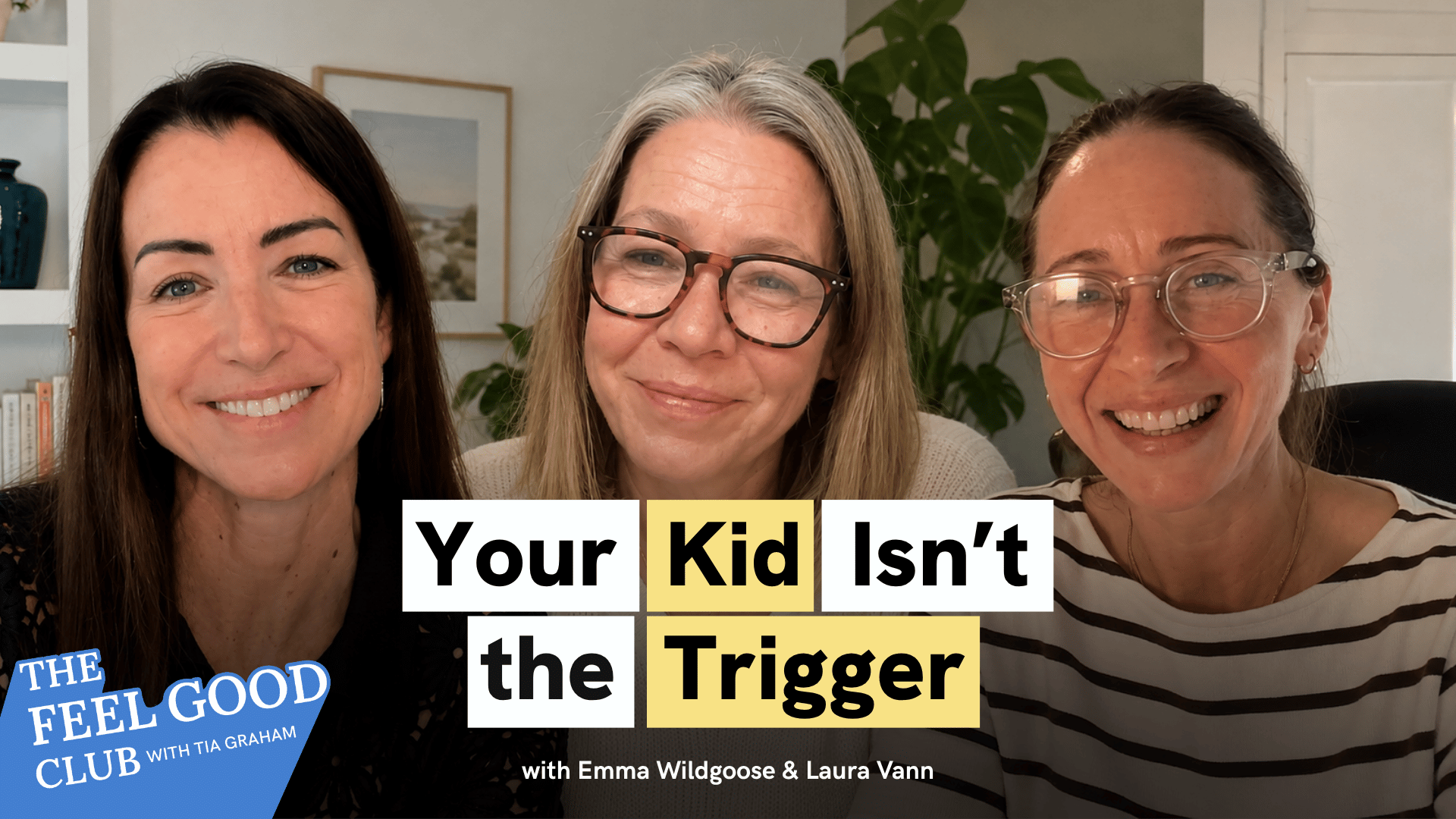



You know what you should do. In the moment, your body does something else entirely.
Here’s How.
Emma and Laura Vann from The Emotions Lab redefined emotional health in a way every working mom needs to hear: it’s not about staying calm, it’s about feeling your emotions without automatically behaving them. Laura explained that most of us were never taught this, we’re used to blaming others for our feelings, or swallowing them down entirely. The real shift happens when you realize your child’s behavior isn’t actually what’s flooding you. It’s the stress response that behavior activates in your body, often tied to old history your child has nothing to do with.
That’s why two parents can witness the same meltdown and feel completely different things, one grounded, one flooded, depending on what their own nervous system remembers. Emma and Laura offered a practical path forward: separate the fact from the story you’re adding to it, turn inward toward the part of you that needs attention before reacting outward, and rehearse your response before the real moment hits, the same way you’d practice scales before a concerto. None of this requires perfect calm. It requires choice.
HERE ARE THE 3 KEY TAKEAWAYS FROM THIS EPISODE:
1️⃣ Emotional health means feeling your emotions without automatically reacting to them.
2️⃣ Your child’s behavior often activates your own history, not just the present moment.
3️⃣ Turning inward before reacting outward gives you more choice in how you respond.
THE 5-MINUTE SELF-CONNECTION PRACTICE
This free resource will help you interrupt the shame spiral after a hard parenting day and reconnect with yourself in just 5 minutes.
“ It happened once and after I did it once it became extremely easy.”
Guest Appearing in this Episode
About Emma and Laura
Emma and Laura are sisters and the founders of The Emotions Lab, where they help mothers build emotional health, self-compassion, and nervous system regulation. Drawing on their own lived experience raising challenging, high-needs children, they created a practical approach to help moms respond from choice instead of fear.
Full Transcript
Tia Graham (00:01.601)
Laura and Emma, welcome to the Feel Good Club Podcast.
Emma (00:07.054)
Thank you. Thank you for having us.
laura vann (00:07.323)
Sorry, thank you for having us.
Tia Graham (00:10.561)
I'm gonna jump in because as I said before I hit record, we could probably talk for three hours and we are gonna give a lot of value over the next 25 minutes. What is emotional health for a working mom with neurodivergent children? And second question: how is vulnerability connected to emotional health?
laura vann (00:38.813)
So emotional health, regardless of who you are, is really the ability to feel and experience the full emotional way that we are as humans without needing to respond in a way that we don't want to. So it's the ability to feel and I always say to our clients, not behave our feelings. So know what to do with them.
Tia Graham (01:06.319)
Mm.
laura vann (01:08.313)
know how to respond to them without blaming somebody for them, taking them out on our kids, which is w tends to be what happens, or our husbands, and actually feeling them ourselves. And the way that it's linked to vulnerability is one of the reasons that I I think especially for a a working mom, this is maybe where it comes in more is it can be difficult, is because
Tia Graham (01:17.357)
Or our husbands.
laura vann (01:37.617)
When you're emotionally healthy, you're okay to be vulnerable. And that means really daring to be seen as a feeling being. And we were raised as females, I think, to really swallow that down. So when you are emotionally healthy, you are okay to experience and be and feel and show that to somebody else. So that's where the vulnerability piece comes in.
Tia Graham (02:04.942)
Thank you for that explanation. The hardest part of that, in my opinion, is I think you said it as not behaving your feelings. Right? Because a lot of times things happen quickly. Of course, there are triggers, there are parts from our childhood, etc. so
laura vann (02:17.808)
Yeah, yeah. Yes.
laura vann (02:25.68)
Mm.
Tia Graham (02:30.496)
I'm sure that this is a process. This is something that you get better and better at over time with intention and healing and choice and support. because this is not something that most people are taught to not behave your feelings.
laura vann (02:52.112)
Yeah, so I would say absolutely we haven't been taught. I d I haven't met anybody who can do this well. it it's not even something we know is a problem. So we are very used to behaving our feelings, we are very used to blaming other people for our feelings. And actually being a human that takes responsibility for that, you're kind of swimming against the stream. it's not known, but it is transformative. The thing that I would
Emma (02:54.136)
Thank
laura vann (03:22.114)
not h I I would hesitate to say to your listeners is it's not quite as difficult as everybody thinks once you have the information that you need and you understand how to do it. And when we founded the company it was all about the fact that nobody and and we were in touch with all sorts of professionals told us how to change in the moment that we were acting at our worst.
Tia Graham (03:47.735)
Mm-hmm.
Tia Graham (03:51.406)
Mm-hmm.
laura vann (03:51.442)
Whether that be extreme rescuing or outrage, everybody said it was a process and it you know, we'd have to think about this, that and the other, but no one actually said how. And we focused very we really focus on helping mums change in that moment as quickly as we possibly can help them do that. And it actually it's not and and my message is not as hard as you might think.
Tia Graham (04:12.591)
Mm-hmm.
Emma (04:18.69)
I think it's also, you know, we look at what actually is driving behaviour and that's not even known. So it's our thoughts and our feelings and actually our stress response in our body driving that behaviour. But unless we, what we tend to do is just focus on the behaviour, which is just the bit we see, we never actually get to the root of the problem, which is everything underneath that's driving it. So that's why we end up, you know, acting our behaviour rather than, you know, expressing our feelings.
Tia Graham (04:40.772)
Mm-hmm.
Tia Graham (04:46.862)
Yes.
laura vann (04:47.025)
And that that's what I mean about it being once we had that information, we found that stress response piece is not talked about at all. But once a mum knows that her stress response is activating at the perceived threat of her child's behaviour, she's she's then got some agency, got some understanding. And we still then have to know what to do. but it's that information my sister gives her.
Emma (04:55.69)
Never talked about it, yeah.
Tia Graham (05:06.553)
Yeah.
Emma (05:10.894)
Yeah, and we can have compassion for the child because once we see that their behaviour is being driven by stress response as well, then we can also start to look at their behaviour through a very different lens. So it's a complete and utter reframe really.
Tia Graham (05:27.159)
Right, right. So I think about how when my daughter, older daughter, was having a lot of very big stress responses and she has a nervous system disability, huge behaviors, and how different my husband's nervous system and my nervous system reacted, responded, behaved to that.
Emma (05:43.073)
you
laura vann (05:55.901)
Mm-hmm.
Tia Graham (05:56.016)
And you know, it's embarrassing. I will say I was embarrassed for how long it took me to recognize that, she's triggering things from my childhood. My husband didn't have those things in his childhood. So her nerve his nervous system is not remembering screaming because he didn't grow up with screaming. And so
laura vann (06:10.653)
Mm-hmm.
laura vann (06:22.151)
Yeah.
Tia Graham (06:26.391)
you know, in the moment for me, as I think I I told you when we first talked, it was a lot of somatic practices in the moment that got me out of my head and into my body and and just getting present with what was going on right now and not, you know, re using my somatic practices to also be like, this is not your living room when you're six years old.
laura vann (06:35.219)
Mm-hmm.
Mm-hmm.
Emma (06:54.424)
Nah.
laura vann (06:54.428)
Yeah.
Tia Graham (06:54.659)
This is you as a 44-year-old in your living room with this child, your body feels like it's it's the same, but it's not. And so, you know, from my experience, my lived experience, if you have traumatic things in your childhood, it, you know, it's it's it's a very different experience having a child like this.
laura vann (07:01.949)
Yeah.
Emma (07:18.562)
Yeah, I think, I mean, we cover this, go through weeks and weeks of it in our programmes where we're taking a mother and looking at all that baggage that she brings into the moment. So her history, her trauma, her social, you know, society makes women a certain way. We're conditioned to be good girls or, you know, we couldn't be angry, you know, all of these, it all comes in at the point that you're triggered. And so we unpick that with the mums we work with and really help them to see that.
actually that stuff just isn't useful in the moment with the present, you know, fear or situation, I suppose. It's just not relevant to what she's dealing with at this precise moment in time.
Tia Graham (08:00.611)
Right.
laura vann (08:01.043)
And yeah and I think that bit you said here is so overlooked and it's not really a concept we really understand properly, but when you do, which I know you do, that you know, that that exists as and not taking away from any of our stories, but it exists as a story. It doesn't exist in that moment, like you say. If I can get myself here and now and just say, you know, I like to say, you know, child saying words.
Tia Graham (08:23.171)
Right. Right.
Emma (08:24.142)
Bye.
laura vann (08:29.649)
What is how do we separate what's a fact that we would all agree on, as opposed to the emotional response I'm having to it? And once I've got that agil I call it emotional agility in our work, like I've I can then see it. So if I, for example, walked in and saw your child's behaviour, I wouldn't have the same response because I'm able, because she's not emotionally pulling me, to separate the fact from the emotional response. And once we understand
Tia Graham (08:37.785)
Right.
Tia Graham (08:54.351)
Course.
laura vann (08:57.777)
You know, I I when someone says, my child won't come out of their room, you know, it's child on bed until I arrive with my story that you're talking about for this backpack of stuff that comes into the room with us. And then your child is it your child is trying to have a relationship with you through the backpack of stuff. Yeah. And so absolutely like you're right, you bringing yourself into that moment.
Tia Graham (09:10.873)
Yeah.
Emma (09:12.056)
you
Tia Graham (09:16.835)
Right.
Emma (09:17.281)
We are past,
laura vann (09:24.189)
But these are all different like that so different skills work for different people, but it's actually helping mums in that moment. That's the memory.
Tia Graham (09:31.216)
Right, right. I see it, I see it all the time now, and you probably relate. Just when I'm out, out and about with my kids, I see how parents and like because I've done so much work and help others, I I like takes everything in me to not go and like swoop the child and be like, you know, I saw it just recently at one of my daughter's therapy when I was this mom getting so reactive with her kid who didn't want to go in. And I wanted to be like,
laura vann (09:48.775)
Yeah. Yeah. I know. Yeah.
Tia Graham (10:00.889)
Just give him five minutes. Like don't rush him. You're stressed out. He just, you know, cause yeah. So okay.
laura vann (10:02.291)
Mm. Yeah.
Emma (10:03.81)
Mm-hmm.
laura vann (10:06.355)
Yeah. We we we go out we go to school in the morning. I take my sister my daughter up the road to school and there's this mum, exactly as you described, walking with a little boy that looks like us my son did when he was little, and Eliza and me in the car. So Eliza is my daughter who I had all the struggles with. We sit in the car going, my god, can we not just go and say to her, You don't need to do it this way. But we think that's all that's available. I I mean, yeah, I t totally I find
Tia Graham (10:30.018)
Yes.
Yeah. Yeah. No, and it's a blessing, you know, having these kids, there's so many blessings once you're once you've done lots of work and you can see about how, yeah, like the best teachers. So let's let's talk about in the moment. And there are feelings, there are there's physiological reactions, there are
Emma (10:47.374)
Mm-hmm.
laura vann (10:52.21)
Mm-hmm.
laura vann (11:01.927)
Yeah. Mm-hmm.
Tia Graham (11:02.297)
Thoughts, and it is really, really uncomfortable, right? And and you are feeling so much anxiety, or you are just bubbling with anger. How can we tolerate feelings in our body in the moment and not act or like you say, behave?
Get really granular to your kid is triggering you.
Emma (11:34.67)
Thank
laura vann (11:37.63)
So I think I think some of this we need to look at outside of the moment. And I think there that so first of all there's not one answer that's gonna that's gonna land for all of us. We'll have to experiment, but if we kinda look at the principles. So that outside of the moment, some very powerful things are for me, I made a decision. I am not going to do this anymore.
Now, of course I did do it again, but there was an understanding with myself that I'm not I do this is not gonna be my story is what I wrote in my book. I am not gonna have this ending with her. I had a vision before she was born of the relationship we had would have and it wasn't that. So the decision is almost like I'm stepping up for myself. It doesn't mean to say Yeah.
Tia Graham (12:26.959)
I'm gonna choose to change.
laura vann (12:29.691)
And it and it's at that moment I I I've done it a few times in my life, I just take the decision that I'm going this is not going to be our story. So I think outside of the event there are things like that, and understanding as well that if I want to change how I feel in the moment and that feels impossible, why don't I try to do that in my imagination first?
So I would spend a lot of time thinking about situations in our house that had ended up with me I mean, I remember in COVID, I would be sitting in my kitchen like actually trying to pull my own hair out. And so I would I would go back to that moment and work out what what would I have done wha how could I have changed course now that I'm not emotionally driven? And I would just experience that in my own head. It's like, you know, if you wanna play
Concerto piano on the stage, you would do some scales at home first. You would do a little practice. So
Tia Graham (13:27.811)
And so you're talking about visualization.
laura vann (13:30.481)
I am, yes. So I'm visualizing you can also bring that. I'm a massive fan of meditation. I wasn't doing it then though, but I'm now because I realize how powerful it is. But it's almost like there's we talk about an identity shift. So who is the version of me already within me that would turn up in that moment w a and could handle that? What would she say? How would she look? What would her face do? And outside of that moment, I'm preparing myself. Now the thing that gets me
Tia Graham (13:54.319)
Mm.
Emma (13:58.351)
she can often be the woman at work actually as well. So sometimes, you know, in that identity shift, it might be that the mum steps into her career identity where she is the confident kind of able to handle things person. So it's using that other part of you, I suppose.
Tia Graham (14:22.777)
Right, right.
laura vann (14:24.551)
So that identity shifting is happening outside of the event. So how does she make her coffee? How does she drive her car? So all of a sudden I start to become her outside of the moment. And that that's the work I did. And then inside of the moment, there was a a very clear moment in time where I stopped avoiding feeling it and I actually decided or stayed and felt it.
And the thing that helped me most in that moment that I now teach is that I learnt how to turn to face inward before I went out. So how I would describe it is there's a child inside of me that needs my help in that moment more than she needs my help. And that child is battering my body down, going, come on out, I might this isn't fair. She can't speak to you like that. And what I learnt to do
Tia Graham (15:20.781)
Also you're picturing you're picturing little you in your body and she wants to get out and go deal with whoever is making you have these feelings.
laura vann (15:24.039)
Yes. Inside. Yeah. Yeah. Crazy. Yeah. And I would say to people that then if she's out and I don't address her, she's gonna parent my child. So my five year old is gonna try to help my daughter have a panic attack. And that's not gonna work. Yeah. So she's in my body hammering, going
Tia Graham (15:44.227)
This is a great visualization tool. Yep.
Yeah.
laura vann (15:51.56)
This is unsafe, this is unsafe. Because like you're saying, I wasn't allowed to feel I like this would not have been an acceptable way of behaving. Plus, you know, I'm now responsible and this isn't going very well. So what is that saying about me? So all of this is going on in me. So if I don't address her, she's gonna go nuts. She's gonna get bigger. So what I did, I remember I was sitting on my daughter's bedroom floor and at the time she's having nightly panic attacks, like huge panic attacks.
Tia Graham (16:05.241)
Right, right.
laura vann (16:20.369)
And I sat on the floor, I got very low, I let go, and I d I d I s like I always say to people, turn around and face yourself. It was all you've got to remember, turn around, turn around, turn around. 'Cause everything is going outwards, right? Your response is going out towards the child, towards the child, change the child, change the And you do this flip and you you hear and you're like, It's okay, you're safe. It's all right, we're safe. I'm an adult, you're safe, I've got this, I'll help her. You don't need to.
And I did it once and that's why I would always say to anyone listening, it feels sometimes that this stuff is like insurmountable, but it happened once and after I did it once it became extremely easy. It was like I I felt something and did something I'd never done before and it translated in all like my life.
Tia Graham (17:09.293)
Right. Well, it's like what psychologists call self-perception theory. You now have the perception of someone who can do that. Did have you done any therapy yourself?
laura vann (17:13.405)
That's it.
laura vann (17:22.835)
Yeah, it's in me like have I been in therapy? Yeah. yeah.
Tia Graham (17:25.571)
Have you been in therapy? Okay, yeah, because that's a veil of of yeah, of the different parts. okay, well, thank you for sharing that. I that's the first time I've heard that I've done a lot of inner child work, but like the the the picture of her wanting to get out and wanting to go. I think that's really, really good. So what does emotional health look like in day-to-day life?
For a working mum with a challenging child.
laura vann (17:58.622)
So that's an interesting question. We were debating actually before we came on. I I I didn't quite understand the answer that you were looking for here in terms of what we want to discuss, but I can tell you what it looks like for me as someone who I think has yeah. Yeah.
Tia Graham (18:12.047)
Yeah, I'd love to hear from both of you kind of day to day, now that you have emotional health and you teach emotional health.
laura vann (18:17.457)
Yeah. Yes. So ch it looks like choice and it looks like freedom and it looks like peace. Never calm. We're not trying to be calm. That's the biggest message I try k that you I want you to be emotional, I want you to feel, I want you to express, I want you to tell people if it's safe, how you feel. But it looks like choice because if I can get up in the morning and decide how well how is my day going today, I'm you know, my sister and I are founding a business, it's extremely challenging.
And we have goals and we want to go at them a hundred miles an hour. If I am now pulled by the emotional state of my fourteen year old daughter and my husband and the news, I'm not gonna get there. So if I'm not and I can choose to respond to the world and other people the way I want to, then I have ultimate choice over my life and I live
in a very peaceful way in my body and I think my sister and I we've probably got more challenges in our life now than we've had before. yeah, so we're our dad died a couple of years ago, our mum's got yeah. yeah.
Emma (19:16.044)
Hmm. Ever. When the sandwich is. Parents dying, neurodivergent kids setting up a business.
Tia Graham (19:18.626)
Really?
Tia Graham (19:23.479)
I'm sorry.
laura vann (19:28.399)
Mum's got trauma induced dementia. Like we we don't have like this, you know plane sailing existence, but we we we absolutely take out of the day ever like we have so much energy and we we yeah, we just we can process it. We it's like that present thing. You say I I am in the present moment of my life as much as I can be.
Tia Graham (19:52.688)
And then even though life still is a roller coaster, you're not riding the huge ups and downs like you did before you learned everything that you know. Sorry, Emma, what were you gonna say?
Emma (19:53.164)
I think, I think.
Yeah.
laura vann (20:00.989)
Yeah. Yeah.
Emma (20:03.778)
Yeah, I think there's another important piece for me actually when I first started to go into this work, because I came at it from a very somatic angle, trained in tapping and what have you, but I found it really useful and I still do in terms of looking after my emotional health, that my physical health is, I'm not suggesting that I'm an absolute, you know, health freak and I kind of, but.
I will do something like a cold plunge in the morning because when dad was dying actually, I used to do that and realise if I can tolerate this very, very difficult feeling in my body going into cold water, I can do it with other big feelings. using things like cold water therapy, making sure I've had enough sleep because all the stuff we do with emotional work is brilliant. But if I'm under-slept, my capacity is reduced.
Tia Graham (20:37.943)
Mm.
Tia Graham (20:48.919)
yes.
Tia Graham (20:54.103)
I am a psycho if I'm sleep deprived. Like no one wants to be around me. No, I agree.
Emma (20:57.14)
Exactly, yes exactly. So we talk about having this sort of landscape we call it, where we're looking after you know what we're eating, you know our sleep, are we moving, all the things that would cause extra stress in the body that we don't necessarily think about being related to emotions but they really really are.
laura vann (20:59.055)
Yeah. Yeah.
Tia Graham (21:13.284)
Yes.
laura vann (21:17.563)
Yeah.
Tia Graham (21:17.867)
Yes, everything you're saying. So I study and teach the science of happiness, right? And there's this model of well-being. It's your spiritual health, physical health, which is mind and body, intellectual health, relational health, and and emotional health. yeah, when you were saying that cold plunges, so I've never done cold plunges, but I love, love weight lifting. And and for me, it's like
Emma (21:22.754)
Okay.
Emma (21:26.52)
Yeah. All again. Yeah. Yeah.
laura vann (21:39.697)
Yeah, me too.
Emma (21:39.864)
Yes, exactly, that.
Tia Graham (21:42.936)
You know, and it's hard. It's not like, this is so fun and easy, like a little bike ride. No. Yet I feel I'm like, I can lift these heavy weights, like I can do hard things. You know, I'm I'm strong. Right? Because it is that that's like another the other uncomfortable thing.
Emma (21:43.768)
Game changing, yeah.
Mmm.
laura vann (21:51.325)
Mm-hmm. Yeah.
Emma (21:51.416)
Yep. Yes, yes, exactly that. Mm-hmm. Yeah, yeah.
laura vann (21:55.496)
Yes. Yeah. But that that that comes into what I'm talking about as well. You know, I was saying it it's outside of the event as much as it is inside of the event and prepare so like you're saying, you become a powerful person. So you know, there's a different identity to someone who can lift heavy weights or someone who can sit in a cold plunge. It it feels different, doesn't it? so it's like that identity shifting on the side as well.
Tia Graham (22:07.587)
Right.
Tia Graham (22:25.379)
Right, right. so if the beautiful, amazing woman listening is thinking, wow, this all sounds amazing, but I am triggered like daily. I, you know, I I am not I am behaving my emotions. What are one or two just small baby steps?
laura vann (22:41.683)
Mm-hmm.
laura vann (22:45.511)
Yeah.
Tia Graham (22:52.377)
this listener can take something really, really small and tangible to just, you know, maybe, maybe improve over the next, you know, 30 days. What would you say? Just really little things.
laura vann (22:52.467)
Mm-hmm.
laura vann (23:04.029)
So I would say
The first thing I think we have to think about is how we speak to ourselves in our heads. So when when you are up against that, you feel like you are dreadful, like a dreadful parent. And that unf yeah, the shame, it's I mean that's one of the wonderful things about what we do. We bring women together and they realise they're not the only one. And I felt like I was the only one. So
Tia Graham (23:14.799)
Mm-hmm.
Tia Graham (23:23.331)
Yeah, shame.
Tia Graham (23:32.227)
Yeah.
laura vann (23:36.808)
You know, in order to make a change, you have to like yourself enough. You know, you have to feel you it's like that Yeah, you really do. And I think one of the smallest things, and I always think with things like this, you're like, you know, some really is that gonna help? It so helps to just catch yourself and say, you know, there is no success or failure. That's just a scale you decided.
Tia Graham (23:43.609)
I wanna say love yourself. Yeah.
laura vann (24:04.687)
It just is what it is right now, and try to come at it without your judgment. This is where I am, and I accept where I am, and in the future I would like to make some changes. But it makes sense that I am where I am because this is something I don't understand yet. And I'm excited to understand it more. So I would say something around compassion for self.
Tia Graham (24:07.116)
Mm-hmm.
Tia Graham (24:16.163)
Mm.
Tia Graham (24:23.012)
Yeah.
Tia Graham (24:29.315)
Yes. no, I love the science of self-compassion. Life, life, life changing. And I'll share for the listener. I started saying to myself, I am such a great mom before I actually believed it. Now I believe it. I'm like, I am an awesome. Like I even when I mess up, even you know, and I started saying that because I was like, I want to believe this, you know, there's things that are getting my way, but I want to believe this. And so
laura vann (24:33.66)
Yeah.
laura vann (24:55.997)
Yeah.
Tia Graham (24:59.021)
You know, the way you talk about yourself when you mess up and you're like, Yeah, I messed up, like I'm a human. Try my best. I get to try again tomorrow.
laura vann (25:05.571)
I so yeah, I I had a lot of success in my own life by just changing things like that and saying it over and over before I believed it. I love that. I always say to mums that you have to you have to keep going before you believe it's possible. That's the hardest part, right? Before you can see any evidence, any result, you gotta keep going. And my favorite one is Lori, you are always gonna be okay 'cause you have you and your team. Right. And I've got I've got
Tia Graham (25:14.009)
Yeah.
Tia Graham (25:30.049)
Love it. I love it. Well, Laura and Emma, where can people go to learn more about you and follow you?
laura vann (25:41.149)
B do you want to do that one?
Emma (25:42.275)
Yeah, can do. So we're on Instagram and we're the underscore emotions underscore lab and our website is www.theemotionslab.co.uk
Tia Graham (25:58.351)
Awesome. Well, like I said, I wish I met you a decade ago, but I'm so grateful that I know you now. Thank you so much for coming on the show.
laura vann (26:07.399)
Thank you, Tia. It was a pleasure. Real pleasure.
Emma (26:07.778)
Thank you, Tia. Thank you for having us.