
How to Live in the Tension Between Ambition and Family Without Burning Out
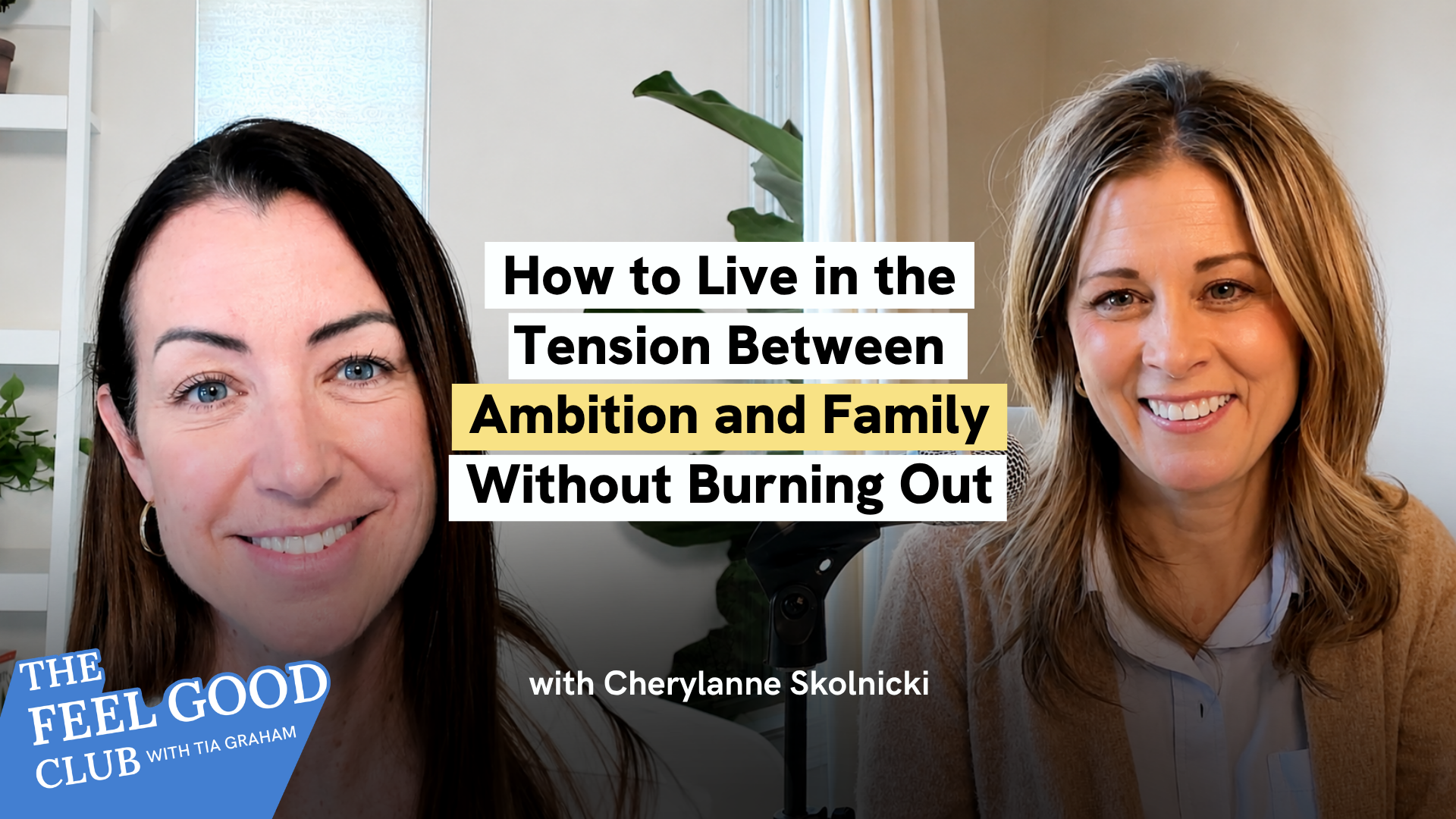



Small choices and better structure can make the whole week feel lighter.
Here’s How.
In this episode, Cherylanne Skolnicki names what so many busy moms feel but rarely say out loud: life can feel like a rubber band stretched in two directions, work and home, both demanding your best at the same time. The goal isn’t to eliminate the tension, it’s to stop fighting it and start adjusting it. When you make small, intentional shifts (instead of chasing a perfect split), you regain peace and momentum in both roles.
Cherylanne’s practical approach centers on agency. You have more choices than you think, especially when you pause long enough to see them. Try mapping what you want more of and what you’re ready to let go of, then match your commitments to your current season of life rather than an outdated standard. When you lead with choice instead of obligation, you reclaim energy, protect what matters most, and feel more like yourself again.
HERE ARE THE 3 KEY TAKEAWAYS FROM THIS EPISODE:
1️⃣ Tension is normal.
2️⃣ Choices create balance.
3️⃣ Seasons require new rules.
THE OVERCOMING MOM GUILT TOOLKIT
Grab the FREE THE OVERCOMING MOM GUILT TOOLKIT
This free resource will help you finally make your home life happier and more balanced.
Get the Free THE OVERCOMING MOM GUILT TOOLKIT
“Living in the tension is a skill, not a flaw.”
Guest Appearing in this Episode
Cherylanne Skolnicki
Cherylanne Skolnicki leads the Coaching Circle, a program built to help high-capacity women turn insight into action with structure and accountability so life feels lighter. She coaches women through real-life situations and teaches practical tools, rhythms, and decision frameworks that protect emotional bandwidth and headspace. Her focus is helping women move out of max-capacity overwhelm into a more intentional way of operating, aligned with what matters now.
Full Transcript
Tia Graham (00:02.338)
Hi, Cheryl Anne, welcome to the Feel Good Club show.
Cherylanne Skolnicki (00:06.275)
Well, hi, thanks for having me.
Tia Graham (00:08.494)
Oh my gosh, I'm so excited. You have an incredible background and you are raising a beautiful family as well. So you did your bachelor's at Cornell, got an MBA from Emory, 15 years as a marketing executive at Emory and you've been an entrepreneur for many years and you have helped thousands of women, of successful women ease the tension between their ambitions
and their family lives, and also how to help them make room for themselves with their busy, busy lives. And I know a listener listening has a busy life right now. So let's just get right into it. How exactly have you taught so many women how to ease the tension? Because...
Cherylanne Skolnicki (00:49.069)
gas.
Tia Graham (01:05.89)
There is tension and someday it is really, really, what's the word, strong or thick.
Cherylanne Skolnicki (01:07.471)
Ugh.
Cherylanne Skolnicki (01:11.905)
Yes, like you could get pulled into. Yes. I think it's every day. It's an everyday occurrence. Well, I choose that word ease very carefully. I think that there's a distinction between ease and eliminate that is important. I am not of the belief that we will ever fully eliminate the tension.
Tia Graham (01:15.287)
Yeah.
Cherylanne Skolnicki (01:32.072)
If you kind of picture a rubber band being pulled in two opposite directions, you kind of loop one finger under each side, the only way to fully alleviate the tension, of course, is to let go of one side. And the women that I am serving and working with every day are not interested in doing that. They're really interested in being both and people like you, like me.
Tia Graham (01:53.637)
We're not going to drop our kids off in some island.
Cherylanne Skolnicki (01:55.502)
We're not going to let go of one side, right? And so because that's like an unacceptable alternative, right, to let go of either thing, we're really deeply fulfilled by both, we have to learn to live in that tension and to make peace with it and to sort of mitigate it and move within it. And I think if you just go back to that rubber band analogy, how would you ease the tension? Well, you'll move the two sides a little closer to each other or you kind of constantly are adjusting. And that dynamic
willingness to adjust for seasonality, for things that change in life, for the ages and stages of kids, for the ebb and flow of career. think that's the answer, is navigating that tension with some dexterity. That's been my life's work so far.
Tia Graham (02:42.508)
I love the analogy. So how would you describe this feeling and this experience of acknowledging and there's always tension, yet it's not too much, right? That's why you're saying easy. It's like you're finding this space, this place that works and then of course it's always shifting is what you're saying.
Cherylanne Skolnicki (03:09.679)
suggesting, right?
Tia Graham (03:11.33)
How does an ambitious working mom with young kids know and feel confident that this is the right amount of tension right now?
Cherylanne Skolnicki (03:21.549)
Yeah, for me, right? Well, and I think it's deeply personal. So let's start with this. I think the key for most of us is we would like to be able to manage more, right? I think if I asked any listener today, what's your ultimate goal? It's like, well, I want to be able to have an even bigger life without feeling like I'm getting crushed by it. And that is true for my clients as well. if
Tia Graham (03:44.012)
And it's a bigger life career. Are you talking about career wise?
Cherylanne Skolnicki (03:46.863)
I'm talking about all of it, right? Like, I want a big, full, juicy life and the freedom to enjoy it. I don't want to be sort of indebted to that life where every moment of every day is scripted and scheduled to things that are beyond my control just so that I can have the life. I want to be able to kind of be in the driver's seat of managing the pieces and parts. So, you know, I want really robust relationships with my kids. I want to really...
thriving marriage, I want to take amazingly good care of myself, I want deep female friendships. Those are all parts of this big full life in addition to I want a kick-ass career. So if you want all of that, then figuring out how those things coexist without breaking you is the important lesson that we have to teach. for anybody who's coming into my world for the first time, we're starting, what does it look like?
to be managing this life in a way that protects freedom for you in the midst of it, where there's kind of room for you right in the middle of that very full life. What does that look like in practical reality? And honestly, Tia, it is a little bit different for each person. The things that I want and need to feel healthy and whole and human are going to be a little different than the things that you need. If we laid out what does a great week look like?
we're just going to have different elements in it. But let's say one of them for me is like, I want to be able to read. I love to read, voracious reader. I have to be able to have space for that in my life. That doesn't mean that I need to sit down for three hours with a book all by myself doing nothing else. I cart a Kindle around with me absolutely everywhere I go, right? I...
Tia Graham (05:23.971)
Mm-hmm.
Tia Graham (05:34.734)
I've an iCard and a with me all around in the car. Yeah, same.
Cherylanne Skolnicki (05:38.159)
That is just, can slide that into slivers of space that would otherwise be wasted doom scrolling or whatever, okay? But someone else who doesn't find reading to be a passion doesn't need to do that. They're gonna find other things that are like extremely important and meaningful that they need to protect space for in their day. So I think, first of all, just getting a good picture of what does it look like for you to have room for yourself in the middle of that life. And then,
Really, the skill building is around, I guess, first adopting the premise that way more things are choices than we think they are. We walk around saying, I have no choice. It is what it is. What am I supposed to do? Yes, I have to. And the reality is we have so many choices at the macro and micro level of our life. And so really kind of pulling back, like,
Tia Graham (06:21.154)
You Seth, you did. You did.
Cherylanne Skolnicki (06:33.782)
revealing that there are, in fact, choices there to be made is an early piece of skill building. And then learning why we don't make them. Once you see them, I think you still have to find the courage, the confidence to make those choices. And that often requires withstanding some significant feelings. We have some pretty big emotions about it. Or dancing with some fears.
Tia Graham (06:39.48)
Yeah.
Tia Graham (06:58.113)
Okay.
Cherylanne Skolnicki (07:01.399)
We can talk about what some of those are, but there's some core ones that bubble up a lot when we start really trying to make those choices.
Tia Graham (07:08.438)
my gosh, I love the Dancing with the Fears. And as you know, I study and I teach the science of happiness. And so when you were talking about the micro and the macro choices, immediately the word I was thinking of was agency. Like we have way more agency than we think, believe, than it feels like, but I love how you described it. And so...
Cherylanne Skolnicki (07:16.301)
Yes.
Cherylanne Skolnicki (07:23.171)
Yes.
Cherylanne Skolnicki (07:27.374)
That's right.
Tia Graham (07:34.914)
You talked about a little bit, but I want to hear more from you about the mindset and the thinking that a working mom needs to kickstart this and then also sustain it because, you know, it is easy to fall back into patterns or beliefs or ways of just operating in our week. So yeah.
Cherylanne Skolnicki (07:49.837)
Yeah.
Cherylanne Skolnicki (08:01.775)
That's right, default. Yes.
Tia Graham (08:04.482)
Talk to me about your thoughts around mindset.
Cherylanne Skolnicki (08:08.184)
Process. Yeah. So I think that the first intervention around mindset is really getting women to kind of unlock this insight that what is right for you changes by season. And in my world, I define season maybe a little differently than people think at first. It's not really like, I'm single, or I'm newly married, or I have young kids. It's more like, are you in a season of growth and expansion? Which all of us
want to be in all the time and think we're in all the time, but we're not. So are you in a season? Lucky you of growth and expansion. Are you in a season of crisis and survival? Are you in a season of transition and change? So we have like seven that we look at that there really are kind of a different operating manual for these different seasons of life. And once you've decided I'm going to honor the season that I'm in and align my life to it instead of fighting with it,
then a lot of those choices start to reveal themselves. OK, so we stop trying to play by like an outdated playbook and we go, what is actually right for right now? And the good news is the right now changes rapidly because these seasons, we don't stay in them forever. Even if you're in crisis, and God bless you if you are, you won't stay in it forever. Like these, they do end and we move on to the next chapter. So acknowledging what season you're in and then I take people through kind of a choice wheel like a
10 question prompt that gets to, what am I going to prioritize in this season? What's in? What's out? What do I want more of? What do I want less of? And they're hard questions to you, right? Because we don't actually usually pause long enough to ask them. We're just barreling through life reacting to whatever is coming at us with the expectation that if someone asks us to do it, the right answer is yes immediately and then to get busy producing whatever that is, whether that's a kid, a spouse, a boss, a
Tia Graham (09:51.214)
Yeah.
Cherylanne Skolnicki (10:03.661)
you know, colleague. And so inserting that moment of choice where we can sort of look at every opportunity and say yes or no, all or some, you now or later, really starts to give us that freedom of making decisions. So that framework is critical. And again, what's the mindset? It goes back to agency. It's you have to stay consistently in the belief that there truly are choices, maybe with cost. People may be disappointed. You might get judged. You might feel guilt. All true.
Tia Graham (10:32.536)
Yeah, you might put the emotions like you said.
Cherylanne Skolnicki (10:34.114)
Yeah, you might miss out on something. There's kind of, I call them the four horsemen, guilt, FOMO, judgment, and the loss of control. Those four things are the four that most women abhor the most. And so we run away from them as soon as those feelings start to bubble up. And yet, learning to tolerate them for long enough to exercise the option sometimes gets us the freedom to whatever's on the other side.
Tia Graham (11:01.42)
my gosh, so powerful. For me, I also, what's been really helpful is just reframing it, you know, cause I struggled with pretty crippling working mom guilt for a long time and my kids have challenges. So I was in that crisis mode for years and different things, but like whenever I do feel the guilt, I'm like, it's because I care so much. Like I'm such a good mom. Like I now just have these, like I'm feeling it, but you know,
I'm a really, really great mom. you know, kind of creating that space, like you said, to feel the painful emotions, but to actually experience them differently, like cognitively and physically. Yeah.
Cherylanne Skolnicki (11:41.998)
Transmute them. and here's here's let me just give you this insight about guilt that I think is powerful like guilt in My definition of guilt is it's the belief that someone else's life will be worse because of my actions. Okay, when we say mom guilt We're not talking about doing anything morally reprehensible. We're talking about guilt that arises because I have inconvenienced Someone so that I can have what I want
Tia Graham (11:55.49)
Yeah.
Tia Graham (12:05.538)
Right, like I'm going on a work trip and my kids are missing me. Yeah.
Cherylanne Skolnicki (12:09.035)
Right. And I think that's the place where we want to challenge, is that even true? Is our narrative and story about that accurate? Or is it that we feel like we're missing something? And so actually, it's more FOMO than guilt. Sometimes what's happening there is more, gosh, I'm going to miss that moment. I can't be in two places at one time. And so some of that values-based decision-making that allows you like,
moment to moment to make a different choice, one work trip versus another, that really is governed by, I missing like a Monday and Tuesday? Or am I missing something that I don't get a second shot at being there for? Sometimes helps eradicate a little bit of that guilt. really, I mean, I think guilt in the truest definition is like we did something wrong, did we? You know, it's such a flip of the choice of word.
Tia Graham (12:51.79)
Sometimes that, yeah.
Tia Graham (13:01.614)
Well, for me, think it's way more, instead of FOMO, it's more of this like cultural societal conditioning of, it's this old, old track, maybe from like great, great, great grandmother of like a good mom is with their kids. And it's like, no, actually, know, the world needs working women now more than ever. So.
Cherylanne Skolnicki (13:16.941)
That's right. That's right. That's right.
Cherylanne Skolnicki (13:26.871)
And kids need multiple people in their lives. Yeah, they need a stable, attached caregiver, but they also need to learn that there are lots of people they can go to for support and entertainment and love. so I think that is a kind I loved that whole expectations conversation because I do think we carry the weight of those expectations into all of these choices. And it's one of the things that blocks us is the narrative or the story we're telling ourselves about the event.
Tia Graham (13:29.047)
Yeah!
Tia Graham (13:36.034)
Yeah.
And
Cherylanne Skolnicki (13:53.901)
And if we can just challenge it one or two times, sometimes we can get repetitive freedom from that particular path.
Tia Graham (13:59.266)
Yeah, yeah, absolutely. I definitely have. Like, for sure, for sure. And what about, so you talked about reading. Can you give a few other micro, easy, simple behaviors for a working mom that's gonna ease the tension a little bit? And like you say, make room for yourself in the middle.
Cherylanne Skolnicki (14:03.438)
You're like, I got there.
Cherylanne Skolnicki (14:15.127)
Sure.
Cherylanne Skolnicki (14:27.529)
that these are the things that ease the tension, but I can tell you that what I refer to as resilience rituals, the things that you do for yourself on a regular basis, just because they make you feel, I said it before, a healthy whole and human, right? That's my phrase for it. Identifying what those are and getting them baked into your week first is a transformational habit, right? It's a completely transformational habit.
Tia Graham (14:52.206)
And let's just, I wanna put baked into your week first. So you are planning these, scheduling these, and they're as important as the meeting or, yeah, yeah.
Cherylanne Skolnicki (14:57.676)
Yes.
Literally anything else, yes. Yeah, and I think 100 % of women sleep is one of those things. I'll fight anybody who tries to tell me otherwise. mean, just am 100%. And yet, still to this day, the women who refuse to adopt that as a truism for them, it's true for other people, but not for them.
Tia Graham (15:08.59)
yeah.
Tia Graham (15:12.716)
Research supports it. We need it.
Cherylanne Skolnicki (15:23.853)
is enormous, right? So adequate sleep is one of those things. I always think of sleep as like it sets the bookends for your day. If you know you're gonna get eight hours of sleep, you got 16 hours to work with sister. Like that's it. You can't turn 16 into 18. You're gonna get what you get and then you're really, it's a forcing function to optimize and maximize those hours. So I think sleep is one. I think good food, movement, know, time outside, right? Like we're plants.
It's just our ability to kind of treat the human mechanism. We really need to do those things. One of mine is time alone. I'm an only child. I grew up with a lot of time alone. It is very important to my just being to have time where no one needs me. I don't get a lot of that. I'm getting more as my kids get older. But I needed to keep a sliver of it in every day that I was able to not have anyone need me at work or at home for small points.
know, periods of the day. You know, for some people, it's deep connection time with their spouse or partner. For some people, it's a hobby, like music. You know, I have musicians in my community or writers that are like, I just have to have that time, critically important to me. So yeah, the habits vary. But again, I refer to them as resilience rituals because
I think what so many of us are trying to do is manage a bigger, fuller life. Think of it as a, we want to be able to bear more stress. I mean, we don't think of it that way, but it's true, right? And so how do you do that? Will you increase your resilience, your recovery, your ability to come back to it again the next day? So if you're getting enough sleep and you're eating well and you're moving and you're doing things that, you know, I think my like getting ready ritual is one of mine. Like I want to do my hair and makeup every day. It just makes me feel good.
Tia Graham (16:55.832)
Yeah.
Cherylanne Skolnicki (17:17.527)
If I don't do it, I'm not bringing the same energy into the day. That's not true for everybody, right? But it is true for me. So I think we have to know ourselves well enough to know what we need and then to give ourselves permission to do it.
Tia Graham (17:32.138)
and taking the time to do it. All right, my final question is, what advice do you have for an amazing working mom who has a very full life, everything we've been talking about, and is actually doing great in all areas, but is pretty hard on herself, feels like she's not good enough.
struggles with inadequacy, even though everything on the outside and like there's nothing, her boss isn't saying you're not greater. Her company is growing, her kids, like I said, all the things are, there isn't actually a lot of things going wrong, but she constantly feels like, am I doing enough? Am I good enough? I should be more, could, yeah, I would love
Cherylanne Skolnicki (18:16.106)
I could do more. I could be more. Yeah. I mean, first, it's highly relatable, right? Like, this is a highly relatable. You could be describing me or any of the women in my community, the sort of never enough women. I think, honestly, the only thing that has been useful to me and to others is to just examine the cultural conditioning that's driven that. I am highly ambitious. I am probably never going to feel like I'm done.
Tia Graham (18:28.184)
Yeah.
Cherylanne Skolnicki (18:43.616)
But that doesn't mean I can't pause and take in the view from time to time on the journey. So the ability to say, I'm going to pause and take in the view for a minute, whether that is for a Friday afternoon, whether that is for a weekend, whether that is for a season. In my season's framework, we call it harvest and celebration. Every now and then, you've got to be in a time where you're like, I'm just going to.
celebrate what I've accomplished so far and kind of recharge before I take the next hill. So that's been the helpful analogy to me is I probably will never get there. And I think a lot of the women in your audience may feel that way. But you can be proud of how far you've come and still excited about how far you have yet to go. Both two things can be true at the same time.
Tia Graham (19:31.566)
give yourself acknowledgement, yeah, have gratitude, but you're kind of saying, you know, stop and smell the roses as you go. And yeah, yeah, great advice.
Cherylanne Skolnicki (19:38.976)
Here and there. Live a little. know, like I think if we're just like hustle, grind, move, progress, advance, that growth and expansion 100 % of the time, you never live a little. And I think that's kind of the idea of this freedom in the middle of it is the chance to do that.
Tia Graham (19:56.588)
Yeah, and I think just the recognition how much our culture makes us think and believe that we're supposed to be on this hustle, you know, 12 months a year, every single year, like it doesn't, know, what you're talking about in terms of seasons and whether people think seasons of life or different things going on is just that recognition. so then you don't judge.
Cherylanne Skolnicki (20:23.67)
Burn out.
Tia Graham (20:24.462)
but you're not thinking of yourself the same at all times because there's different things happening. So I think that was really, really valuable. thank you so much for coming on the show. I really appreciate it. And if listeners want to find you and follow you, where can they go?
Cherylanne Skolnicki (20:27.766)
That's right.
Cherylanne Skolnicki (20:31.808)
Good.
Cherylanne Skolnicki (20:40.938)
Really the website's the best jumping off place. It's brilliant-balance.com. You can just Google it. It usually comes up pretty early in the search, it's like a jumping off place to all the resources, including the podcast.
Tia Graham (20:53.198)
Perfect. thanks so much again.
Cherylanne Skolnicki (20:55.264)
Thanks for having me.